
Introduction
Homeowners and shops often struggle with tabletops that look worn or unfinished without a costly rebuild. A single bonded sheet of decorative laminate can give a dining table or new top the look of walnut, marble, or a muted solid color. The surface handles daily spills, scuffs, and wipe-downs.
This guide is for DIY homeowners, remodelers, cabinet shops, furniture makers, designers, and commercial project teams. The decisions are similar for all of them: which grade, which finish, which edge, and where the table will live.
We'll define decorative laminate, match it to how the table is used, cover finish and edge choices, walk through installation, and explain indoor and outdoor limits.
Key Takeaways
- Laminate is a finish; the substrate, adhesive, edges, and seams decide how the table performs.
- Choose by use, heat, moisture, abrasion, cleaning, and lighting, not color alone.
- Order samples and read technical data and care instructions before buying.
- Standard interior laminate is not automatically waterproof, heatproof, or suitable outdoors.
What Are Decorative Laminates for Table Tops?
How decorative laminate works
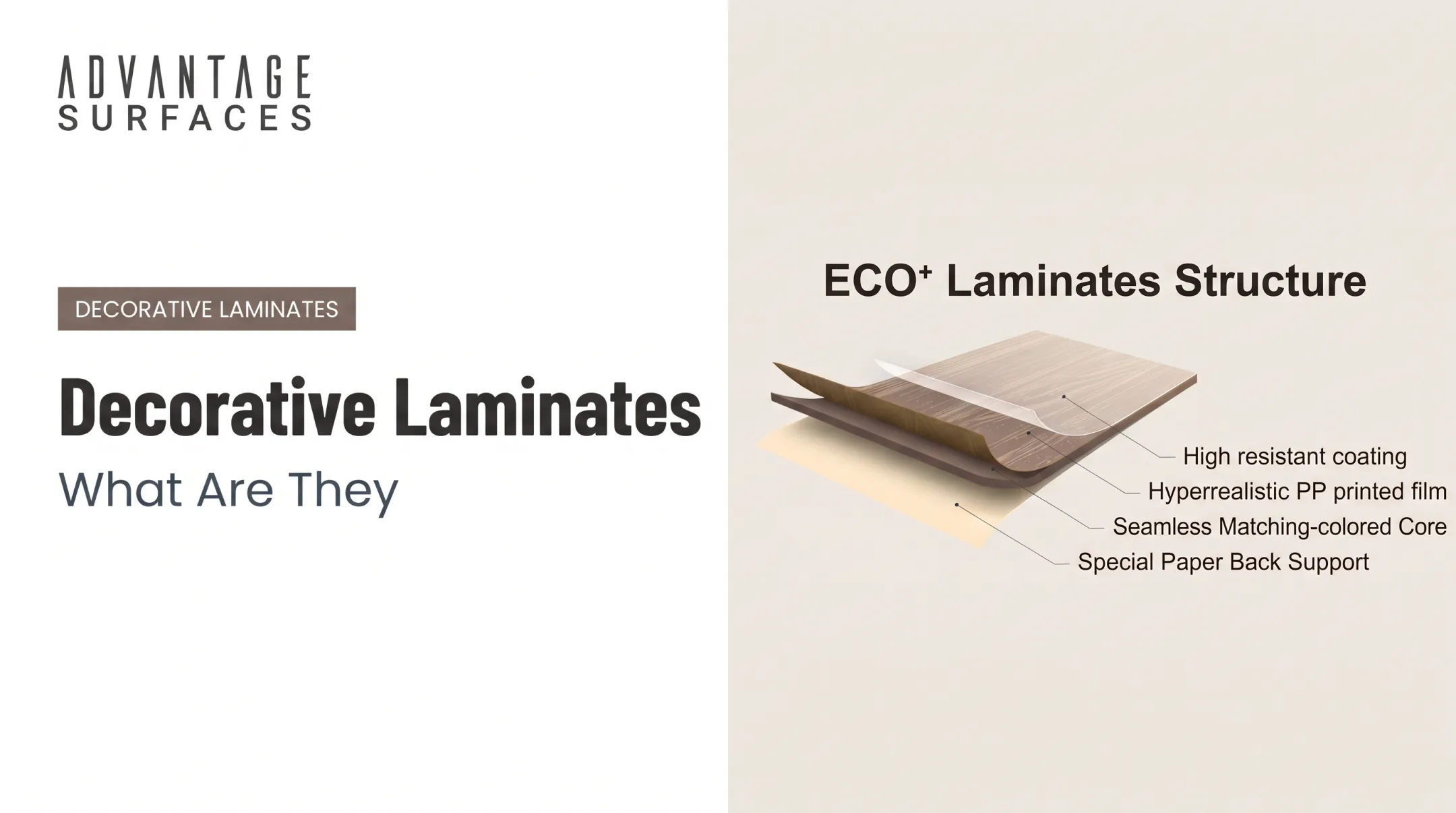
Decorative laminate is a manufactured sheet with a printed or solid decorative face and supporting layers. You bond it to a stable substrate such as MDF, particleboard, plywood, or an existing structurally sound tabletop.
Construction varies by product. High-pressure laminate (HPL) is made from melamine-treated surface papers and phenolic-treated kraft core papers, pressed with heat, then bonded to a substrate.
Compact laminate is much thicker. Formica describes compact grades as at least 1/8 in thick, and 1/2 in or thicker can be self-supporting.
Know what this is not:
- Laminate flooring has a wood-fiber core and wear layer built for floors.
- Vinyl flooring is PVC-based and made for a different job.
- Paint makeovers give a look, not a bonded surface.
True decorative laminate sheet still varies in thickness by grade. Formica lists general-purpose sheet at 0.044 in, horizontal postforming at 0.035 in, and vertical postforming at 0.027 in. Specify the grade, not just "laminate."
Why table makers use decorative laminate
- Wide range of woodgrains, solids, stone looks, and textures
- Consistent appearance from sheet to sheet
- Easy routine cleaning
- Resistance to everyday scratches and stains
- Easy coordination with cabinetry and flooring
Back every performance claim with the specific manufacturer's technical data, especially for heat, moisture, chemicals, impact, UV, and food contact. For example, Wilsonart states that its Basic Types 107, 335, and 350 comply with NSF 35. That statement covers those named products, not all laminate.
Limitations to understand before buying
The visible surface may be tough while the assembly still fails. Exposed edges, poorly sealed seams, standing water, wrong substrates, excess heat, and incorrect adhesives cause swelling, lifting, and chipping.
Formica warns that prolonged exposure to 140°F or higher may separate laminate from its core, and that flooding a surface, especially near seams, can swell the substrate. Check application ratings, warranty terms, and substrate requirements for your product.
Choosing the Right Decorative Laminate for Your Table Top
Start with the table's purpose and exposure
List how the table will be used: dining, food prep, office work, studying, retail display, hospitality, healthcare, education, or light decor. Then list what the surface will face:
- Spills and hot dishes
- Abrasion from laptops, plates, and writing tools
- Cleaning products
- Constant hand contact
Those answers set your priorities: scratch, stain, and chemical resistance; moisture management; and how much fingerprint or glare visibility you can tolerate.
As a reference point, Wilsonart's basic sheet reports typical wear resistance of at least 350 cycles, and its Type 107 explicitly covers tables and desks.
Match the finish to the setting
- Wood grain: warm residential rooms and hospitality
- Solid color: contemporary offices and clean, modern dining areas
- Stone-inspired: coffee tables and statement pieces
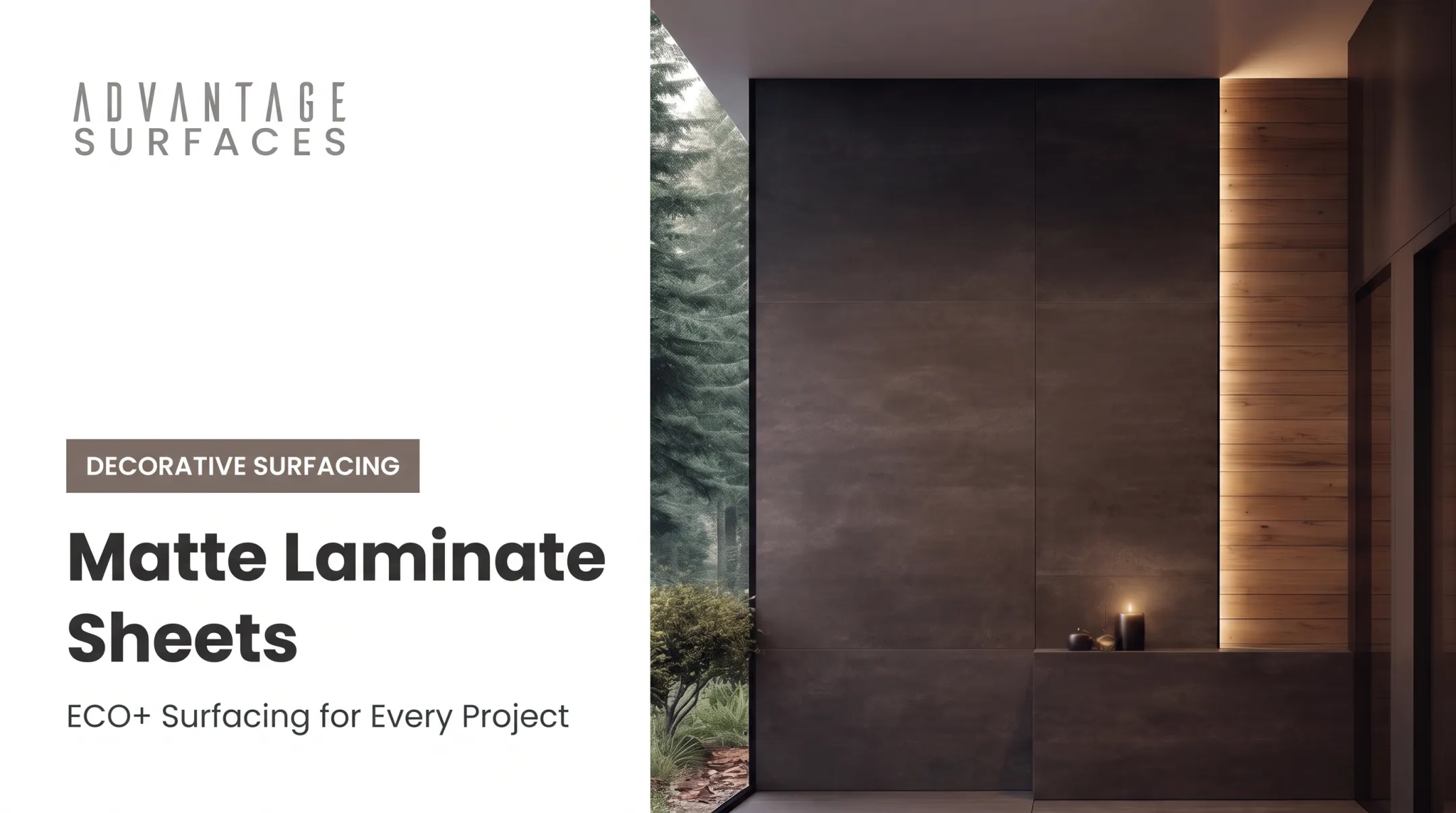
- Textured or matte: high-touch tables where fingerprints and glare matter
- High gloss: focal pieces in controlled settings
Finish names matter. Wilsonart describes its High Gloss as mirror sheen and Timbergrain as low sheen with dimensional texture. Its Traceless line claims fingerprint resistance, but that applies to the named product only. Always judge gloss and color under the room's real lighting.
Plan the substrate, thickness, and edge together
Finished thickness is the substrate plus the laminate and any edge build-up. Use the selected product's technical sheet rather than a universal number.
Wilsonart recommends particleboard or MDF/HDF. Plywood moves differently and can cause warpage, stress cracks, and open seams. Grain can also telegraph through gloss finishes.
Edge options include:
- Matching strips
- Contrasting edges
- Rounded or postformed profiles
- Seamless color-core designs
The edge protects the substrate and defines how the table looks. Before ordering, plan sheet orientation, grain direction, seams, corners, overhangs, and cut allowances.

Review samples and ordering requirements
Request physical samples. Screens misrepresent texture, gloss, grain scale, and undertones. Professional buyers should also confirm:
- Sheet sizes and minimum quantities
- Cut-to-size availability and lead times
- Edge materials
- Installation requirements and certifications
- Warranty documentation
Source KD Keding ECO+ laminates through distributor Advantage Surfaces USA
Advantage Surfaces USA, a distributor of KD Panels (Keding), supplies KD Keding ECO+ laminates to US residential and commercial projects. The company lists these attributes:
- Non-toxic, food-grade polypropylene and formaldehyde-free construction
- An SGS-certified coating for scratch, stain, and chemical resistance
- Flexible, crack-resistant sheets
- Seamless color cores that avoid dark edges at 90-degree corners
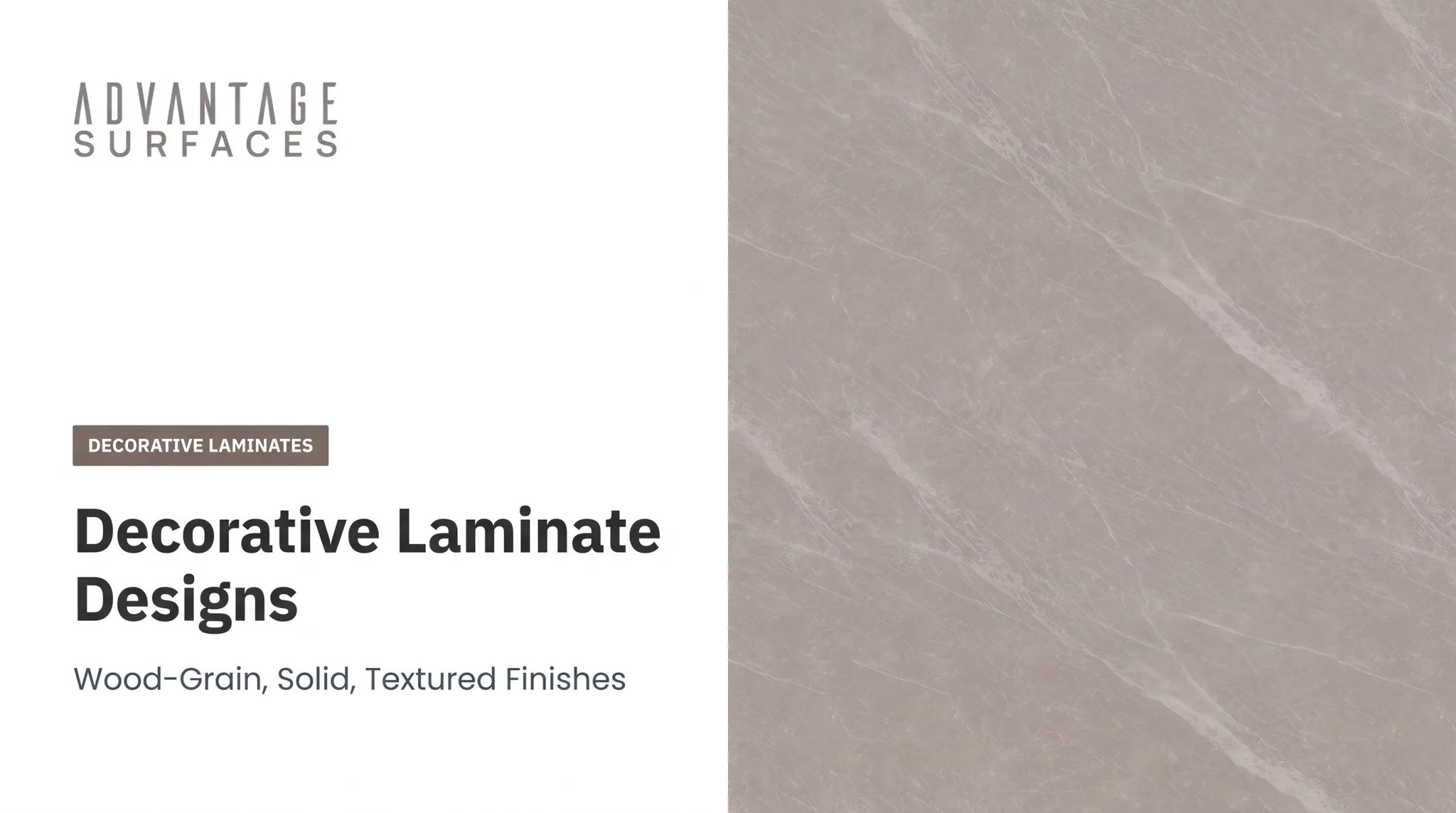
- Wood-grain, solid-color, and textured designs, with over 200 color options
Sheet details and pricing:
- Size: 4 ft × 8 ft standard sheets
- Wood grain: from $105.99
- Extended stone and metal collection: $110.99
- Solid colors: $116.99
- Custom sizes available on request
- $35 sample book includes a $35 coupon toward future purchases
- Free standard shipping within the continental US
Confirm current availability before ordering.
Material composition alone does not establish outdoor suitability or food-contact approval for a finished table. Ask for the technical documentation for your intended use.
Decorative Laminate Design Ideas by Table Type
Dining and kitchen tables
Coordinate wood grains or solids with cabinetry and flooring. Prioritize easy-clean surfaces with suitable resistance to spills, heat, and abrasion.
A low-glare finish and a carefully finished edge usually serve family dining better than a mirror-bright top. Fingerprints, crumbs, and glare show up fast on gloss.
Office, study, and workstation tables
Matte, low-glare wood grains or subtle solids keep a workspace comfortable and hide fingerprints and daily marks. Computers, stationery, pens, and constant arm contact all wear a surface. Confirm the product's scratch and chemical resistance data.
Coffee, hospitality, retail, and commercial tables
Stone-inspired, textured, bold solid, or high-gloss designs make a focal point. Even so, match the finish’s performance to traffic and cleaning frequency.
Commercial, healthcare, education, and hospitality jobs often require documented performance, consistent sheet supply, samples, and professional fabrication. In one Texas elementary school renovation, Wilsonart laminate over MDF was used on tables, with patterns chosen specifically to hide scratching and wear.
How to Apply Decorative Laminate to a Table Top
Prepare the table and substrate
Inspect the top for flatness, stability, delamination, dents, grease, dust, and moisture. Repair, sand, replace, or reinforce as needed. Make a template for irregular shapes, cutouts, seams, and overhangs.
Wilsonart lists existing HPL as an unsuitable substrate on its basic technical sheet, so don't assume you can bond over old laminate.
Gather compatible tools and follow safety requirements
- Tape measure and straightedge
- Fine-tooth saw or other suitable cutter
- Compatible contact cement, with roller or brush
- 3 in rubber J-roller
- Dowel rods
- Flush-trim router, file, and sanding tools
- Clean cloths, eye protection, gloves
Solvent-based adhesives are hazardous. Wilsonart 600's safety data sheet describes a flammable liquid and vapor, and calls for ventilation, no heat, sparks, or flames, and specified eye, hand, and clothing protection. Follow your adhesive's instructions, not a generic routine.
Measure, cut, and orient the laminate
Cut the top sheet oversize so you can trim it flush later. Account for grain direction, pattern alignment, edge strips, corners, seams, and which side is the decorative face.
Make a test cut, and support the sheet while cutting to reduce chipping and cracking. Take exact allowances from your manufacturer's instructions. Condition face, backer, and substrate together for 48 hours before fabrication.
Bond the sheet to the tabletop
- Dry-fit the sheet.
- Apply adhesive to the laminate first, then the substrate. Wilsonart's DIY guide prefers two thin coats over one heavy coat, with full coverage.
- Let both surfaces dry to the required tack. Wilsonart 600 lists 20-30 minutes dry time.
- Lay dowels about 12 in apart and position the sheet.
- Remove dowels one at a time while holding the sheet in place.
- Roll the whole surface with the J-roller, working from the center outward.

Where moisture or heavy use is likely, use a backer on the underside with the same adhesive to limit warping.
Trim and finish the edges
Use a flush-trim router to remove overhang, then file carefully to leave a smooth edge. Work in the direction that reduces chipping.
Install edge strips or your chosen edge treatment. Exposed seams and substrate edges deserve extra attention wherever water may reach them.
Complete, cure, and inspect the table
Remove adhesive residue only with a method the manufacturer approves. Let the assembly cure per the product instructions before attaching legs or putting the table into heavy use. Then inspect:
- Flatness and bubbles
- Lifting at edges or corners
- Sharp edges
- Visible seams and pattern alignment
- Exposed substrate
- Secure attachment to the base
Know when to hire a fabricator
A simple rectangular top suits an experienced DIYer. Large sheets, curves, complex corners, tight seams, commercial quantities, or costly substrates may justify a pro. Ask suppliers about cut-to-size material, fabrication referrals, installation instructions, and technical support before you start.
Care, Maintenance, and Use Limitations
Clean the surface correctly
Wipe with a soft, damp cloth and mild soap or a laminate-safe cleaner, then dry, especially around edges and seams. Clean spills promptly.
Avoid abrasive pads, steel wool, acidic cleaners, and aggressive solvents. Wilsonart permits household bleach or nail-polish remover on stubborn stains for no longer than two minutes, but prolonged bleach exposure can discolor laminate. Follow your product's care guide.
Protect the laminate and its edges
Simple habits protect the face and edges:
- Use trivets under hot cookware
- Place coasters under drinks
- Prep food on a cutting board, not the surface
- Add pads under objects that can scratch or dent
Standing water, damaged edges, direct cutting, dragging heavy objects, and prolonged heat can mar the face or let moisture reach the substrate.
Understand indoor and outdoor suitability
Don't assume interior laminate survives sun, rain, humidity, or freezing. Wilsonart's standard HPL is interior-only and nonstructural, and Formica Compact is not recommended for exterior use.
For outdoor tables, look for products explicitly approved for it. Fundermax, for example, approves Max Compact Exterior for outdoor tabletops, specifying 12 mm thickness, or 10 mm minimum, for screw depth.

If you see lifting or swelling, determine whether it's limited to the surface or has reached the substrate. Then follow the manufacturer's repair guidance or call a professional.
Frequently Asked Questions
Can you laminate a table?
Yes, if the top is stable and flat and the sheet, adhesive, substrate, and edge treatment are compatible. Repair damaged or unstable tops first.
Can I get laminate table tops cut to size?
A cut-to-size laminate sheet is not a finished table top. Confirm dimensions, tolerances, grain direction, edge finishing, and availability with your supplier.
Is laminate good for a dining table?
An appropriately rated indoor laminate can work well. Wipe spills quickly, use trivets, protect the edges, and follow the care instructions.
Which laminate is best for a dining table?
Choose by stain, scratch, moisture, cleaning, and moderate heat needs. Let glare, fingerprints, room style, and samples guide the finish.
What can I use for an outside table top?
Use an exterior-rated compact laminate or weather-resistant panel approved for outdoor use. Standard interior laminate shouldn't be assumed to perform outside.
How do I clean a laminate table top?
Use a soft damp cloth and mild laminate-safe cleaner, and remove spills promptly. Avoid abrasive tools and harsh chemicals unless the product documentation allows them.