
Don't, unless the product documentation says you can. "Heat resistant" does not mean heatproof. Wilsonart's care guide calls for a heat shield, hot pad or trivet under hot cookware and warns that extreme heat can crack or blister laminate.
This guide covers how laminate is built, what affects heat performance, how it compares with other countertops, what to ask a supplier, and how to protect the surface once it's installed.
Key Takeaways
- Heat performance depends on the whole assembly: face layer, adhesive, substrate, edges and seams.
- Keep hot cookware off laminate unless the specific product's documentation permits it.
- Warmth, prolonged heat, steam and sudden temperature swings each carry different risks.
- Weigh heat against design, maintenance, moisture and installation needs.
What Heat Resistance Means in Laminate Countertops
Heat resistance means a material tolerates a stated temperature for a stated time without unacceptable discoloration, bubbling, warping or delamination. Heatproof would mean no limit at all. No laminate manufacturer claims a heatproof rating.
A countertop is a system
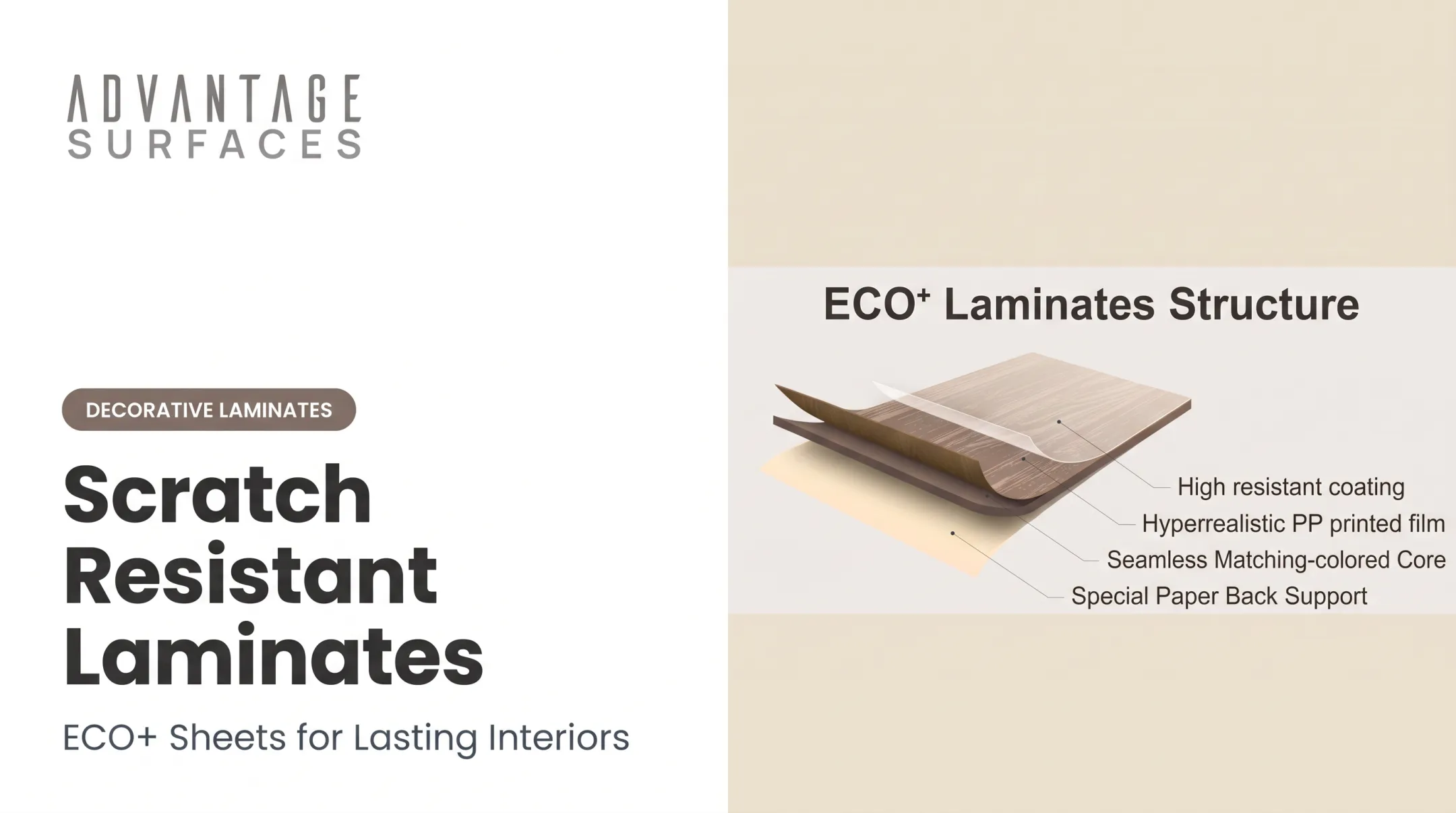
The decorative face is only one layer. Wilsonart describes high-pressure laminate (HPL) as melamine-impregnated decorative papers over phenolic-impregnated kraft-paper core sheets, bonded to a suitable substrate such as particleboard, MDF or one-A-face plywood. Adhesive, backing sheet, seams and edges all matter too.
Heat can fail any of them. NEMA's installation guidance notes that above about 150°F (66°C), bonded laminate can separate from adhesive failure. That is a limit on the bonded assembly, not a rating for the laminate face.
What changes the outcome
- Cookware temperature and how long it sits
- Pan weight
- Steam or moisture
- Repeated heating and cooling
- Whether heat reaches an edge or seam
Reading test numbers carefully
Lab results describe specific conditions. One EN 438 report used an aluminum block at 320°F (160°C) for 20 minutes on a specimen glued to particleboard. That is not a universal service rating.
Manufacturer limits are often phrased as extended exposure. Pionite and Abet both cite 275°F (135°C) as a ceiling for extended exposure, and neither offers an unrestricted hot-pan rating.

Signs of heat damage
- Scorch marks, or gloss and color changes
- Bubbling or raised areas
- Lifting, softening or cracking
- Separation from the substrate
Surface marks may sometimes be cleaned. Bubbling, lifting and separation usually mean the section needs replacement.
How Heat-Resistant Laminates Compare With Other Countertop Materials
Every material here has conditions. None is damage-proof.
| Material | Hot-pan guidance from manufacturers | Notes |
|---|---|---|
| Decorative HPL | Wilsonart: use heat shield, trivet or hot pad | Assembly-dependent |
| Quartz | Cambria, Caesarstone, Silestone: use trivets | Rapid temperature changes can damage it, especially edges |
| Granite | Stone Collection: brief contact possible but not recommended | Thermal shock can crack it; heat can weaken sealer |
| Quartzite | Stone guidance favors trivets; confirm with the slab supplier | Verify per slab |
| Porcelain | Caesarstone porcelain permits cookware from the oven | Constant-heat appliances still need insulated mats |
| Stainless steel | Reform recommends trivets | Excessive heat can damage the surface |
| Concrete | Trueform: no hot pots directly | Heat can damage the sealer |
| Soapstone | Vermont Soapstone says red-hot cookware is not a problem | Statement is product-specific |
| Butcher block | Heat-resistant, not heatproof; hot pads strongly recommended | Per Vermont's FAQ |
Only the porcelain and soapstone statements explicitly permit hot cookware, and only within each manufacturer's scope.
Location matters as much as material
General tolerance is not the same as suitability for a spot. A seam near the sink, the area beside a cooktop, the space under a toaster oven and a busy island landing zone each carry different risks. Heat, steam and moisture concentrate at edges and joints.
Where ECO+ fits
Advantage Surfaces USA is a distributor of KD Panels (Keding), offering KD Keding ECO+ laminates, a polypropylene-based line. Documented features include food-grade polypropylene, formaldehyde-free construction, an SGS-certified coating and more than 200 color options.
The product page lists "Thermal Resistance," but no temperature, exposure time or direct-hot-pan rating is published. Treat ECO+ as a design-driven choice, and don't treat the food-grade or coating claims as proof of heat performance.
When laminate fits
Laminate suits cooks who use trivets consistently, want design variety and a lower budget, and can accept replacing a damaged section. If you routinely move pans from oven to counter, or the consequences of scorching would bother you, a porcelain or soapstone surface may suit you better.

Benefits and Limitations of Laminate for Kitchen Countertops
Design strengths
Laminate offers a wide choice of finishes. ECO+ includes wood-grain patterns (maple, white oak, red elm, cypress and others), muted solid colors and metal, stone and leather textures. Hyperrealistic printing reproduces natural grain, and the matching-color core is meant to avoid dark edge lines at 90-degree corners. The wood-grain collection also coordinates well with cabinets and millwork.
Performance beyond heat
- Cleaning: Wilsonart advises a damp cloth, mild soap and a warm-water rinse.
- Scratches: Steel wool, abrasive pads and heavy scrubbing damage decorative surfaces, especially gloss.
- Chemicals: Panolam warns about prolonged bleach exposure, and Wilsonart warns against acidic cleaners.
- Moisture: Formica warns that flooding near seams lets water reach and swell the substrate.
ECO+ literature describes a scratch-, stain- and chemical-resistant SGS-certified coating that cleans with a damp cloth. ECO+ does not publish a sink-specific moisture limit or edge-impact rating, so ask before specifying it near a sink.
Repair and lifespan
Be realistic. No manufacturer confirms a permanent repair for heat blistering or delamination. Wilsonart's qualifying warranty remedy covers sheet material but not removal, fabrication or installation, and its warranty excludes extreme-temperature damage. No lifespan figure is published either, so prevention beats repair.
How to Select and Install Laminate for a Heat-Exposed Kitchen
Start with your habits
Ask yourself:
- How often do pans come out of the oven?
- Do they land on the island or perimeter counter?
- Do steam-producing appliances sit nearby?
- Will everyone in the household use a trivet every time?
Questions to ask before you buy
- Is direct hot-pan contact permitted, and under what tested conditions?
- What temperature and time limits apply?
- Which cookware precautions are recommended?
- Which substrates and adhesives are required?
- What are the edge and seam requirements?
- What do the installation instructions say?
- What does the warranty exclude?
Requirements vary by brand. Wilsonart permits plywood, for instance, while Abet's North American sheet excludes it.
Build a safe landing zone
Keep a trivet, cooling rack or heat-protective mat beside the oven and cooktop. Don't make an unverified laminate surface your permanent hot-pan station.
Fabrication details that affect heat performance
- Use a stable, well-supported substrate.
- Choose the correct adhesive and let it cure fully.
- Seal edges, minimize seams, and position them carefully.
- Seal sink cutouts in humid conditions, per NEMA guidance.
- Round inside corners on cutouts (Wilsonart specifies at least a 1/8 inch radius).
- Keep laminate away from contact with heat-producing appliances.
Samples versus documentation
Request samples and technical documentation from Advantage Surfaces USA before specifying ECO+. The sample book costs $35 and comes with a $35 coupon toward a first order.
It helps you judge color, texture, edges and fit. Only technical documentation or manufacturer guidance can establish heat limits.
Care and Heat-Safety Practices for Laminate Countertops
Everyday protection
- Put trivets, hot pads or cooling racks under pots, bakeware and countertop appliances.
- Don't trap steam beneath lidded containers or appliances.
- Keep heat away from seams and edges.
Cleaning
Use a soft cloth with mild soap and water. For ECO+, a non-abrasive household cleaner handles tougher stains. Avoid abrasive pads, harsh chemicals and standing water.
If you suspect heat damage
- Let the area cool.
- Photograph any discoloration or lifting.
- Don't sand or scrape without manufacturer approval.
- Contact the supplier or fabricator about repair, panel replacement or warranty review.
Abet, for example, voids its warranty if repairs happen without prior written authorization. For ECO+ products, Advantage Surfaces USA asks customers to contact them promptly about damaged or defective items.

Frequently Asked Questions
Can laminate countertops withstand heat?
Laminate tolerates some everyday kitchen warmth, but hot cookware can cause permanent damage. Check the manufacturer's rating and use a trivet unless direct contact is expressly approved.
What countertops can I put a hot pan on?
Only products specifically rated for that exposure, such as certain porcelain and soapstone products within each maker's stated scope. Thermal shock can still affect heat-tolerant materials, so a trivet remains safer.
Are heat-resistant laminates safe for kitchen countertops?
It depends on the laminate system, substrate, installation and testing. Food-grade or non-toxic claims don't prove hot-pan performance.
How can I protect a laminate countertop from hot cookware?
Use trivets, hot pads and cooling racks, and set up a designated landing zone. Keep hot cookware off seams, edges, sink cutouts and steamy areas.
What should I ask before buying a heat-resistant laminate countertop?
Ask about tested heat conditions, direct-contact guidance, exposure duration, and substrate and adhesive requirements. Also ask about edge limits, cleaning, installation and warranty exclusions.