
Introduction
Picking a laminate sheet thickness feels like a small decision until the sheet won't bend around a curved vanity, or the edge chips the first week after installation. Thickness affects handling, flexibility, edge treatment, and how well the finished surface holds up to daily use.
The right choice depends on more than preference. You need to know the laminate category (decorative HPL, compact laminate, flooring), the substrate it bonds to, how it gets installed, and what conditions it will face.
Manufacturer documentation commonly lists decorative sheet thicknesses as thin as 0.7mm. A finished panel built from that same sheet typically measures 19.05mm (3/4 inch) once bonded to particleboard. That gap trips up a lot of buyers.
This guide covers common decorative thickness ranges, mm-to-mil conversions, sheet sizes, how to verify specs before ordering, and the mistakes that cost the most time and money.
Key Takeaways
- Thickness is usually measured in millimeters; confirm units before comparing mil-based listings.
- Thin, standard, and heavy-duty ranges exist, but application and substrate decide the right one.
- Thicker sheets aren't automatically waterproof, structural, or heat-resistant.
- Finished panel thickness includes substrate and adhesive, not just the laminate sheet.
- Request samples and check the datasheet before ordering in volume.
What Laminate Sheet Thickness Represents
Laminate sheet thickness is the measured thickness of the decorative surfacing material itself, the HPL sheet before it's bonded to anything. It's typically expressed in millimeters on U.S. manufacturer datasheets, and it's a completely different number from your finished panel's thickness.
Here's the relationship that trips people up:
- Laminate sheet: the thin decorative layer, often under 1.5mm
- Adhesive: bonds the laminate to the substrate, with thickness rarely listed separately
- Substrate: plywood, MDF, particleboard, or another approved panel that gives the assembly its bulk and rigidity
A 3/4-inch (19.05mm) finished cabinet door might use a laminate sheet measuring less than 1mm. The substrate does the structural work. The laminate provides the surface.
Thickness is a fabrication parameter, not a strength rating. It influences how easily a sheet flexes around curves, trimming and routing behavior at the edges, edge visibility once installed, handling during cutting and transport, and day-to-day surface wear resistance. It does not, on its own, determine structural soundness. That's the substrate's job.
Use the right term for the right product. Decorative HPL sheets, compact laminate, laminate flooring planks, laminating film, and pre-laminated panels are all different things with different thickness expectations. Calling an 8mm flooring plank "laminate" in the same breath as a 0.8mm decorative sheet creates confusion fast.
Thickness should always be weighed alongside finish and coating performance, core construction, substrate stability, installation method, and panel orientation.
Thicker isn't an automatic upgrade. For a curved reception desk or rounded cabinet edge, a flexible, thinner laminate that postforms cleanly often beats a heavier sheet that cracks under the bend radius. For a high-traffic commercial surface, wear resistance matters more than raw thickness. Match the product to the job, not the spec sheet to your assumptions.

Range of Laminate Sheet Thickness
There's no single industry-wide thickness chart that applies to every laminate product. What follows are application-oriented categories drawn from current manufacturer data. Always confirm exact numbers against the datasheet for the product you're buying.
Nominal Decorative Sheet Ranges
Manufacturer specs for standard high-pressure decorative laminate generally fall into three grade types:
| Grade type | Typical use | Example thickness |
|---|---|---|
| Vertical postforming (VGP) | Curved edges, vertical cabinet faces | ~0.7mm (0.028 in) |
| Horizontal postforming (HGP) | Horizontal surfaces | ~0.9mm (0.036 in) |
| General purpose (HGS) | Cabinet doors, furniture, wardrobes, millwork | ~1.1mm (0.045 in) |
These figures reflect typical published manufacturer technical data, which usually lists tolerances alongside each grade. Exact figures vary by manufacturer and product line.
For comparison, ECO+ laminate sheets distributed by Advantage Surfaces USA are specified at 0.8mm across their 4' x 8' sheets, positioned for flexible fabrication across cabinetry, wall panels, and furniture work rather than one narrow use case.
Whether a thinner or heavier sheet is adequate depends on the substrate underneath and how often the surface gets handled. A rarely-touched wall panel has different needs than a daily-use cabinet door.
Compact and Structural-Looking Products
Compact laminate is a different animal. It's a dense, self-supporting panel that doesn't need a separate substrate in many applications (think bathroom partitions or exterior cladding).
Published manufacturer data lists compact laminate thickness running from about 2.54mm up to 25.4mm (1/10 inch to 1 inch), a completely different scale than decorative sheets.
Don't apply decorative-sheet thinking to:
- Laminate flooring, often sold in planks around 7mm or 8mm with their own wear-class ratings
- Compact laminate panels
- Thick architectural panel products
Each has its own installation standard. Check it before assuming decorative-sheet guidance applies.
Unit Conversions and Terminology
Millimeters, inches, and mils aren't interchangeable without doing the math, and "mil" causes the most confusion. One mil equals one-thousandth of an inch (0.001 in), or 0.0254mm. It's unrelated to "millimeter" despite the similar sound.
Common conversions:
- 3 mil = 0.003 in = 0.0762mm
- 5 mil = 0.005 in = 0.127mm
- 10 mil = 0.010 in = 0.254mm
These are unit conversions, not application recommendations. Mil measurements show up more often in laminating film and plastic sheeting contexts than on decorative HPL datasheets, which typically use mm or inches.
Safe Selection Margin
The safest thickness choice is whatever the manufacturer approves for your specific application, substrate, bend radius, and exposure, not simply the thickest sheet available.
Pushing close to a product's stated limit tends to increase:
- Fabrication difficulty
- Visible edge chipping or cracking
- Poor adhesive bonding
- Warranty complications
Stay inside the manufacturer's tested range to avoid most of these headaches.
Key Technical Properties and Selection Factors
Thickness is one input in a larger performance system. Two sheets at the same nominal thickness can behave completely differently depending on coating, core, and finish.
Flexibility, Cutting, and Installation
Thinner sheets generally bend, cut, and trim more easily, which is useful for curved reception desks, rounded cabinet edges, or tight corners. Thicker sheets may need different tooling, more adhesive coverage, and more careful edge prep.
For curved or postformed work, verify the minimum bend radius the manufacturer tests for. Don't assume a sheet bends easily just because it's thin. Postforming requires a specific product formulation, not just low thickness. ECO+ laminates, for example, are built for flexibility and crack resistance when bending around curved or shaped surfaces.
Durability and Surface Performance
Thickness affects impact tolerance and edge vulnerability to some degree. Coating quality, overlay, and core construction drive most of the scratch, stain, and chemical resistance you'll actually notice. Manufacturer testing for decorative laminate typically covers:
- Stain resistance and cleanability
- Wear resistance
- Radiant heat resistance
- Scratch and impact resistance
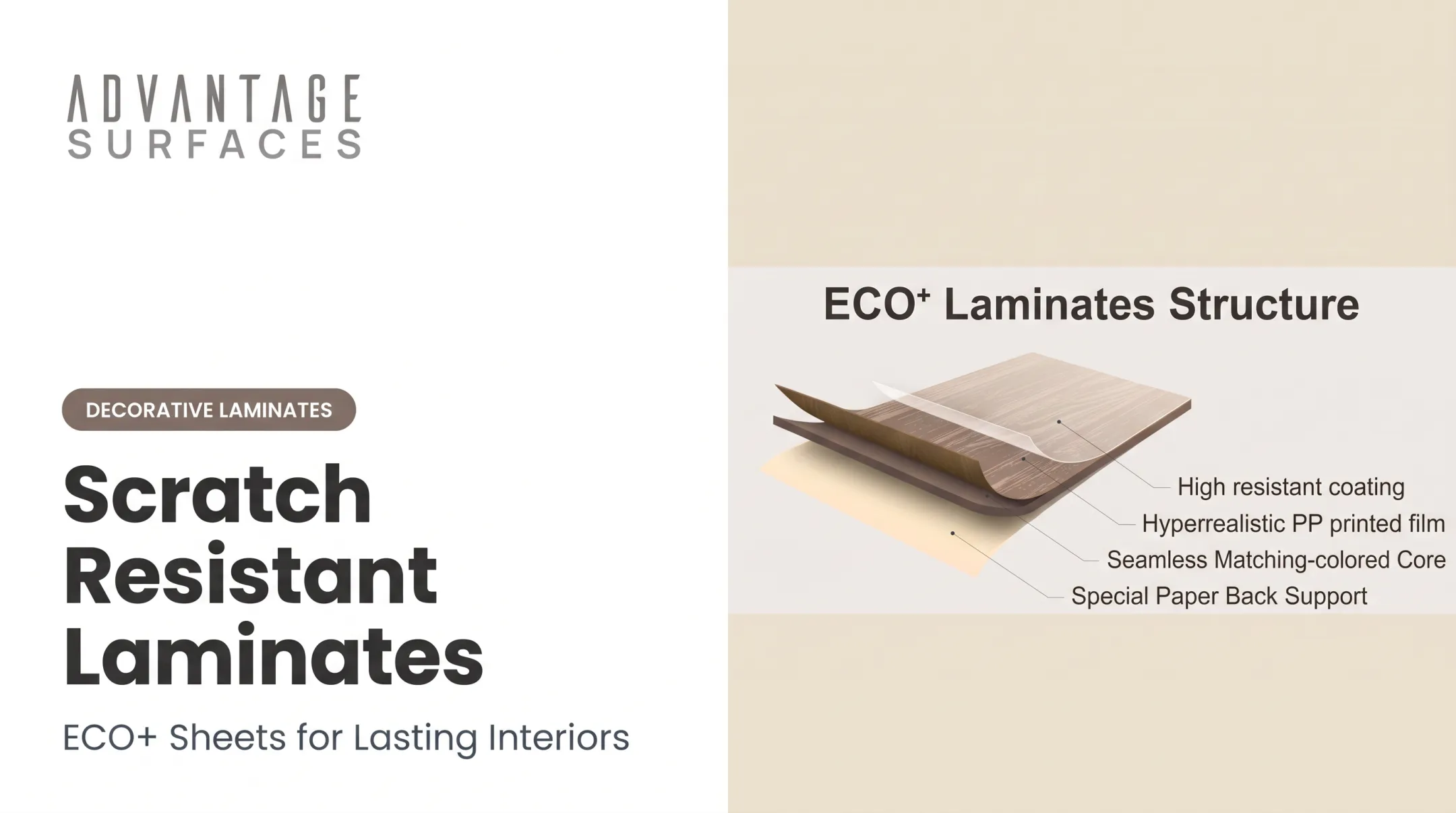
ECO+ laminates use an SGS-certified coating for scratch, chemical, and stain resistance. Confirm those claims against the manufacturer's test data rather than generic service-life numbers.
Substrate and Finished Panel Behavior
A stable, properly prepared substrate is non-negotiable. A thicker laminate sheet cannot fix a warped, damp, or poorly supported panel underneath it. The problem shows through eventually, usually at the edges first.
When specifying a finished panel, balance:
- Laminate thickness against substrate thickness
- Total panel weight against hardware capacity, such as hinges and slides
- Span and support spacing
- Edge treatment and desired appearance
Application-Based Selection
Different applications call for different priorities:
- Vertical cabinetry and shutters: frequent handling favors durable, easy-clean surfaces
- Horizontal work surfaces: wear resistance and heat tolerance matter more
- Wall panels: lighter handling demands, more flexibility in thickness choice
- Commercial casework: higher use frequency, stricter durability expectations
- Curved details: confirm postforming suitability before specifying
Always verify the product's recommended use against its own datasheet, not a similar product's specs. When reviewing a sample, look past color and texture and check:
- Edge appearance
- Bend behavior
- Cut quality
- Adhesive compatibility
- How easily it cleans
Advantage Surfaces USA Product Fit
For buyers prioritizing non-toxic, formaldehyde-free materials, KD Keding ECO+ laminates from Advantage Surfaces USA, a distributor of KD Panels (Keding), offer a design-oriented option built from food-grade polypropylene. A seamless, color-matched core means no visible black edge line at 90-degree corners.

The sheets support flexible fabrication and scratch- and stain-resistant performance across residential and commercial interiors.
Review the ECO+ technical documentation and request a physical sample before specifying quantities for a project. Color and texture only tell part of the story.
How Thickness Is Specified and Validated
Thickness is both a purchasing spec and a fabrication checkpoint. Verify it before cutting or ordering in volume, not after.
Specification and Documentation
Check the product datasheet for:
- Nominal thickness and dimensional tolerance
- Sheet construction, including core, overlay, and finish
- Intended applications and substrate requirements
- Recommended adhesives
- Finish limitations and warranty conditions
A "nominal" value is a target, not a guarantee down to the micron. Manufacturers publish tolerances alongside it for a reason. Confirm which standard your supplier tests against for the product category you're buying.
Measurement and Verification
If you need to confirm thickness on an accessible sheet, use calibrated digital calipers at multiple points for a reasonable field check. Keep in mind:
- Protective film left on the surface skews readings
- Texture and embossing create inconsistent contact points
- Measurement pressure affects the result
Field measurements are a sanity check, not a substitute for manufacturer documentation, especially when ordering replacement sheets, specifying commercial work, or confirming compliance.

Project Checklist
Before placing a large order, confirm:
- Panel orientation (vertical or horizontal)
- Substrate type and condition
- Total finished panel thickness
- Sheet size and cut plan
- Edge details and bend requirements
- Environmental exposure
- Quantity and batch consistency
Request samples from Advantage Surfaces USA or another supplier before committing to a full order. This matters most for architects, designers, and cabinet shops ordering in bulk.
Implications of Choosing the Wrong Thickness
Get the thickness wrong, and the fallout shows up in fabrication, appearance, performance, or all three.
Performance and Fabrication Problems
Common outcomes when the spec doesn't match the application:
- Excessive flexing on unsupported spans
- Difficult or failed bending on curved details
- Chipped or damaged edges during trimming
- Visible joints or inconsistent reveals
- Inadequate impact tolerance for the use case
Each outcome is product- and application-specific. What fails on one laminate line may hold up fine on another.
A thicker decorative sheet doesn't fix moisture damage, delamination, heat damage, or a failing substrate. Those are separate problems with separate causes.
Cost, Compliance, and Warranty Effects
Over-specifying costs money beyond the sheet price itself:
- Material waste from unnecessary bulk
- Higher shipping and handling costs
- Extra tooling or labor to work the thicker material
- Hardware and edge-detail incompatibility
Fire resistance, hygiene standards, chemical resistance, and indoor air quality requirements each need their own verification. Don't assume a thicker sheet automatically clears any of these. Check the specific certification for your project type. Specifying outside the rated thickness range can also void manufacturer warranties or leave claims unsupported.
Common Misinterpretations of Laminate Thickness
A few assumptions cause most of the confusion:
- Treating nominal thickness as an absolute guarantee rather than a value with tolerances
- Assuming "7mm" or "8mm laminate" means a decorative HPL sheet, when it more likely refers to flooring or compact laminate
- Comparing products by thickness alone while ignoring coating, core, substrate, and installation method
- Equating larger sheet size with greater thickness; sheet size mainly affects coverage, pattern continuity, seams, and material yield
Conclusion
Laminate thickness governs how a sheet handles, fabricates, and performs in its intended application. It isn't a standalone measure of durability or structural strength.
Work through the selection process in order:
- Identify the product category
- Define the use and exposure conditions
- Review substrate and fabrication requirements
- Verify the datasheet
- Inspect a physical sample before ordering
For U.S. residential and commercial buyers exploring design-oriented, health-conscious options, Advantage Surfaces USA is a distributor of KD Panels (Keding), offering KD Keding ECO+ laminates. These formaldehyde-free, food-grade polypropylene sheets offer flexible fabrication and SGS-certified scratch and stain resistance.
Review the specs, request a sample, and confirm the sheet fits your project before you cut.
Frequently Asked Questions
Which is thicker, 3 mil or 5 mil?
5 mil is thicker, at 0.127mm versus 0.0762mm for 3 mil. Mil and millimeter aren't the same unit, and thickness alone doesn't confirm a product fits your laminate application.
What is the standard thickness of laminate sheets?
No single standard covers every laminate category. Decorative sheets commonly run 0.7mm to 1.1mm by grade, so check the manufacturer datasheet. Compact laminate and flooring use different ranges.
Is 7mm laminate too thin?
It depends on the product category. A 7mm flooring plank and a 7mm compact laminate panel serve different purposes, so confirm the category and manufacturer guidance before judging thickness.
How thick is 10 mil laminate?
10 mil equals 0.254mm (0.010 inch), using the standard definition of 1 mil = 0.001 inch. That figure shows up more often in laminating film terminology than in decorative HPL sheet specifications.
What sizes do laminate sheets come in?
U.S. suppliers commonly offer 4' x 8' sheets, with some lines extending to 5' x 12'. Larger sheets reduce seams and improve pattern continuity but affect handling, transport, and material waste.
What are the different types of laminates?
Decorative HPL, compact laminate, postforming laminate, specialty grades, flooring, and laminating film are distinct categories. Each has its own thickness range, so match the term to the product before comparing specs.