
Introduction: Why Eco Laminates Are Changing Interior Surfacing
Picking a surfacing material used to mean picking your trade-off. Solid wood looks great but scratches. Stone is tough but heavy and expensive.
Many homeowners and designers struggle with finding a material that looks good, holds up to daily use, and doesn't compromise indoor air quality.
That's where eco laminates come in. These surfacing products combine design flexibility, durability, and healthier material choices for cabinetry, furniture, wall panels, and commercial casework.
But "eco" gets used loosely in this industry. A laminate labeled formaldehyde-free isn't automatically sustainable across its entire lifespan, and a low-VOC coating doesn't tell you anything about the core material underneath.
This article breaks down what actually makes a laminate eco-friendly, what to verify before you specify or buy, and where these materials genuinely perform well.
Key Takeaways
- Evaluate laminates by composition, emissions, durability, and available documentation, not marketing labels alone
- Modern laminates reproduce wood-grain, stone, and textured finishes for cabinetry, millwork, and commercial casework
- Durability and easy cleaning can extend service life, but recyclability still needs product-specific research
- Request technical data, certifications, and physical samples before specifying any laminate for a project
What Are Eco Laminates?
Decorative laminate is a surfacing material bonded to a substrate, typically particleboard or MDF, to create a finished panel face. This is different from laminate flooring, which is a flooring-grade product governed by its own standards.
CPA's glossary distinguishes high-pressure laminate (HPL) from thin fused laminate (TFL). HPL is a separate sheet later bonded to a panel. With TFL, décor paper is fused directly to the board in the press. Keep that distinction in mind. A lot of marketing blurs it.
The Layers That Matter
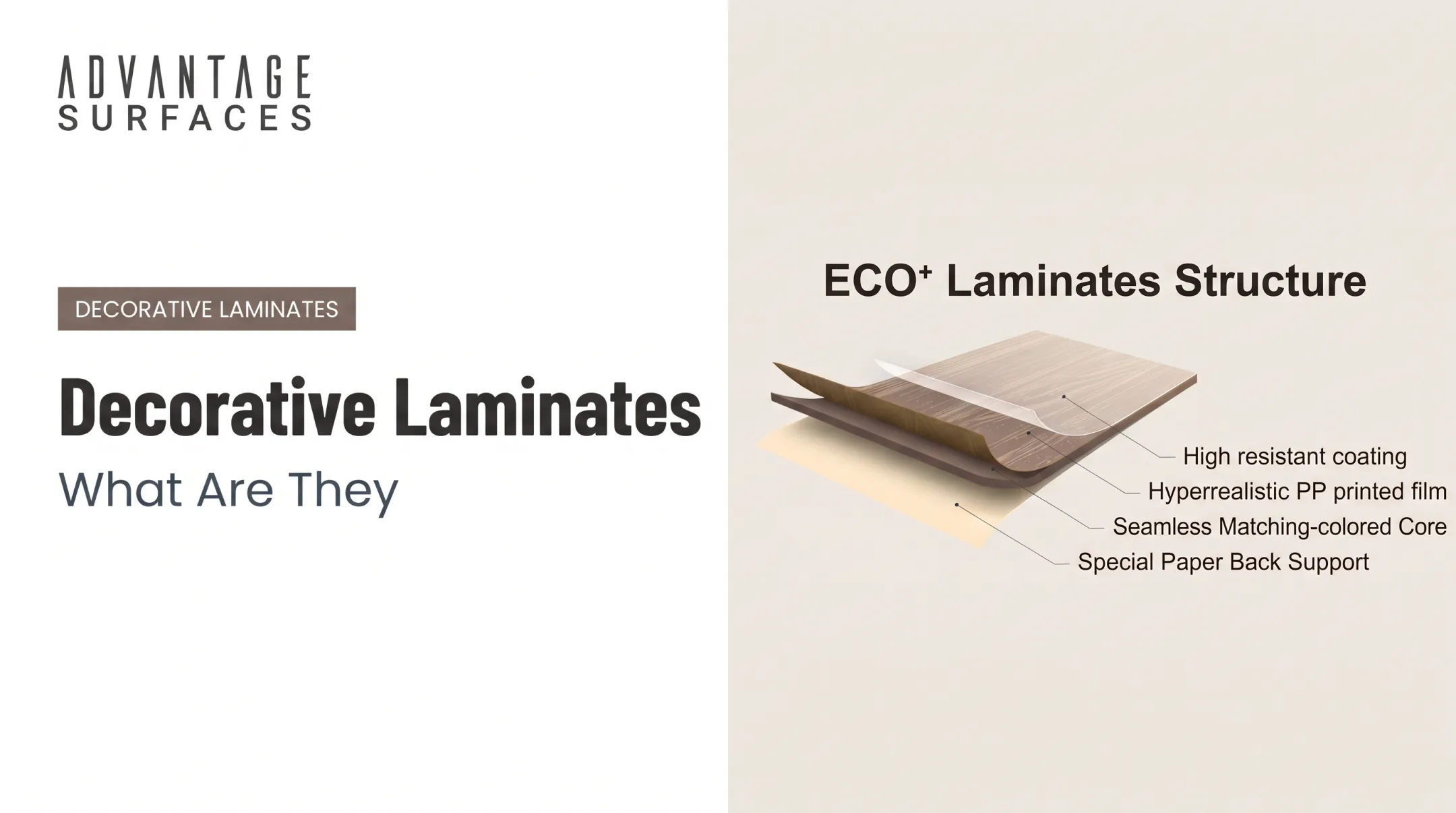
Most decorative laminates share a similar construction:
- Protective coating - resists scratches, stains, and chemicals
- Printed design layer - creates the wood-grain, stone, or solid-color look
- Core or substrate layer - affects rigidity, edge appearance, and sometimes recyclability
- Backing - stabilizes the panel against warping
Each layer can influence sustainability and health differently. A formaldehyde-free core means little if the coating off-gasses VOCs, and vice versa.
What Actually Supports an Eco Claim
A credible eco-laminate claim typically rests on:
- Non-toxic or formaldehyde-free formulations
- Reduced-emission coatings with documented low TVOC levels
- Responsible material sourcing
- Manufacturing transparency
Here's the catch: "eco," "green," and "sustainable" aren't certifications. They're marketing terms. FTC's Green Guides warn that broad environmental claims need substantiation, and a certification on one feature doesn't automatically back up a bigger sustainability story.
Always check the manufacturer's documentation against recognized standards rather than taking the label at face value.
A Real-World Example
KD Keding ECO+ laminates, distributed by Advantage Surfaces USA, illustrate this well. The sheets use non-toxic, food-grade polypropylene and a formaldehyde-free construction, with low TVOC emissions and zero melamine listed among the product's features.
The wood-grain line also carries an SGS-certified coating for scratch, stain, and chemical resistance.
What's not claimed here matters too. There's no published recyclability data or full life-cycle assessment for these specific sheets, so buyers evaluating that angle should ask the supplier directly before assuming an end-of-life outcome.

How Eco Laminates Support More Sustainable Interiors
Laminate can reduce reliance on solid wood or natural stone for certain decorative applications. Hyperrealistic printing now reproduces wood grain, stone veining, and texture convincingly.
That said, there's no verified apples-to-apples study comparing laminate's resource footprint to equivalent solid-wood or stone surfacing in cabinetry. Treat visual substitution as a design option, not a proven environmental win.
Service Life and Waste
Durability matters because replacement cycles generate waste. One published environmental product declaration (EPD) for an HPL wallcovering reports a 20-to-50-year reference service life based on manufacturer warranty data.
That's one product's figure, not an industry-wide number, and it excludes use and maintenance impacts. A surface that lasts longer still avoids the embodied impact of making and installing a replacement.
Indoor Environmental Quality
Formaldehyde and VOC emissions are where "eco" claims get tested. Ask for:
- Product-specific emission test results (not general industry averages)
- Certification documentation with scope and expiration dates
- Confirmation of adhesive and coating emissions, not just the core material
Trade-Offs Worth Knowing
No surfacing material is impact-free. Consider:
- Synthetic polymer components in most decorative laminates
- Limited recycling infrastructure for multilayer sheets
- Manufacturing energy and transportation impacts
- Disposal options at end of life, which vary by local waste systems
A Quick Verification Checklist
Before trusting an eco claim, check:
- Material composition and core type
- Emissions documentation (formaldehyde, TVOC)
- Sourcing and manufacturing disclosures
- Third-party certifications with defined scope
- Maintenance requirements
- End-of-life or disposal guidance
A formaldehyde-free label or a low-VOC coating is one data point. Judge the full picture, not a single feature.
Stylish and Durable Design Without the Conventional Trade-Offs
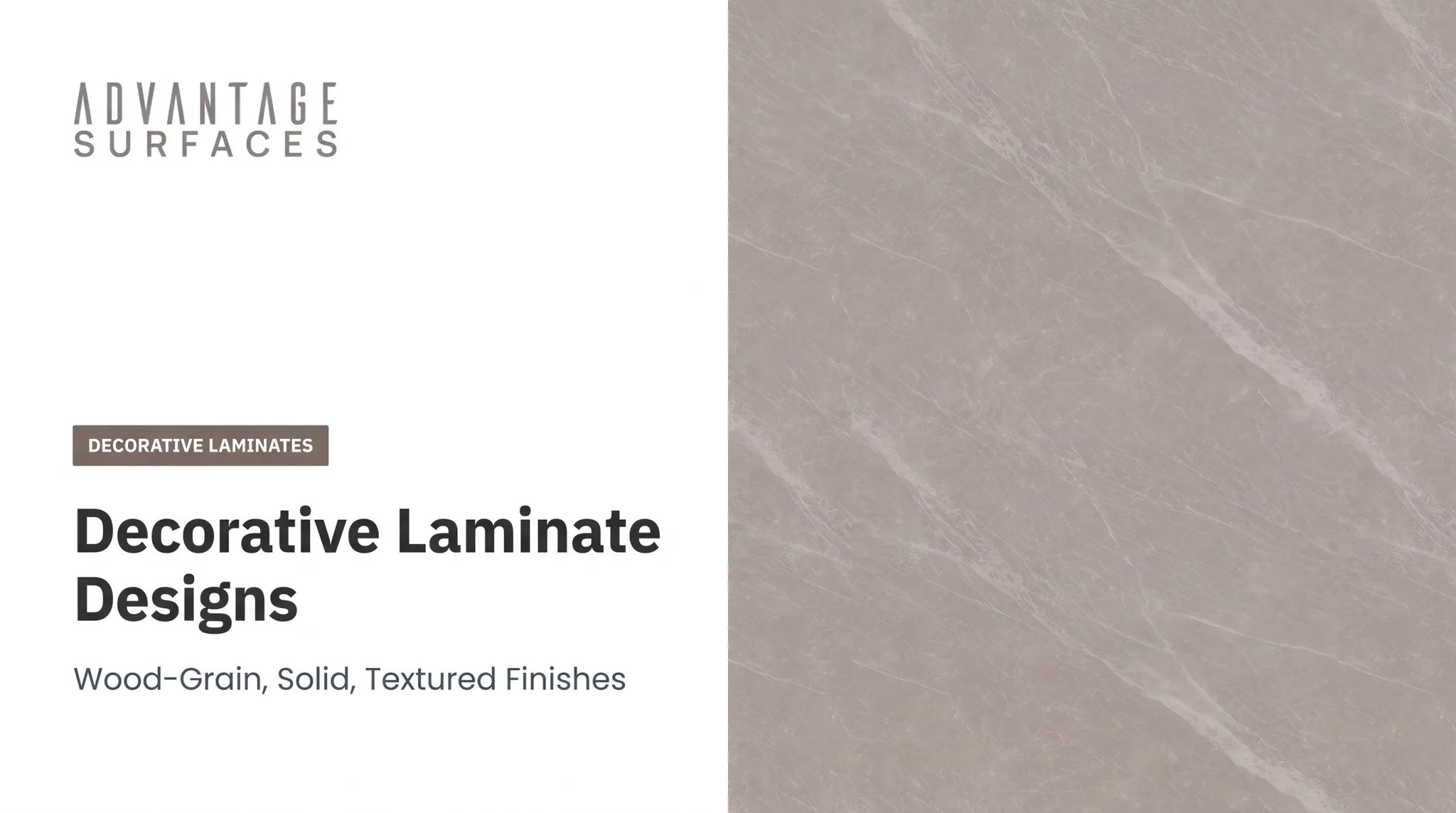
Today's decorative laminates reproduce wood grain, stone veining, solid colors, and tactile textures so convincingly that most people won't guess it's not the real material. That opens design options without sourcing exotic wood or quarrying stone, and without giving up day-to-day durability.
What to Compare for Durability
Not all coatings perform equally. When comparing products, look at resistance to:
- Scratches and everyday wear
- Stains, solvents, and alcohol
- Household chemicals
- Moisture and humidity
- Heat from nearby appliances
ECO+ sheets distributed by Advantage Surfaces USA use an SGS-certified coating rated for scratch, chemical, stain, solvent, and dirt resistance. Ask any supplier for their specific test data rather than relying on general durability language.
Seamless Edges Change the Look
Here's a detail that's easy to overlook until you see it: exposed 90-degree corners on cabinetry often reveal a dark, contrasting core line. Seamless color-matched cores eliminate that black-edge look, giving a cleaner, more finished appearance at corners and cut edges.
Flexibility and Fabrication
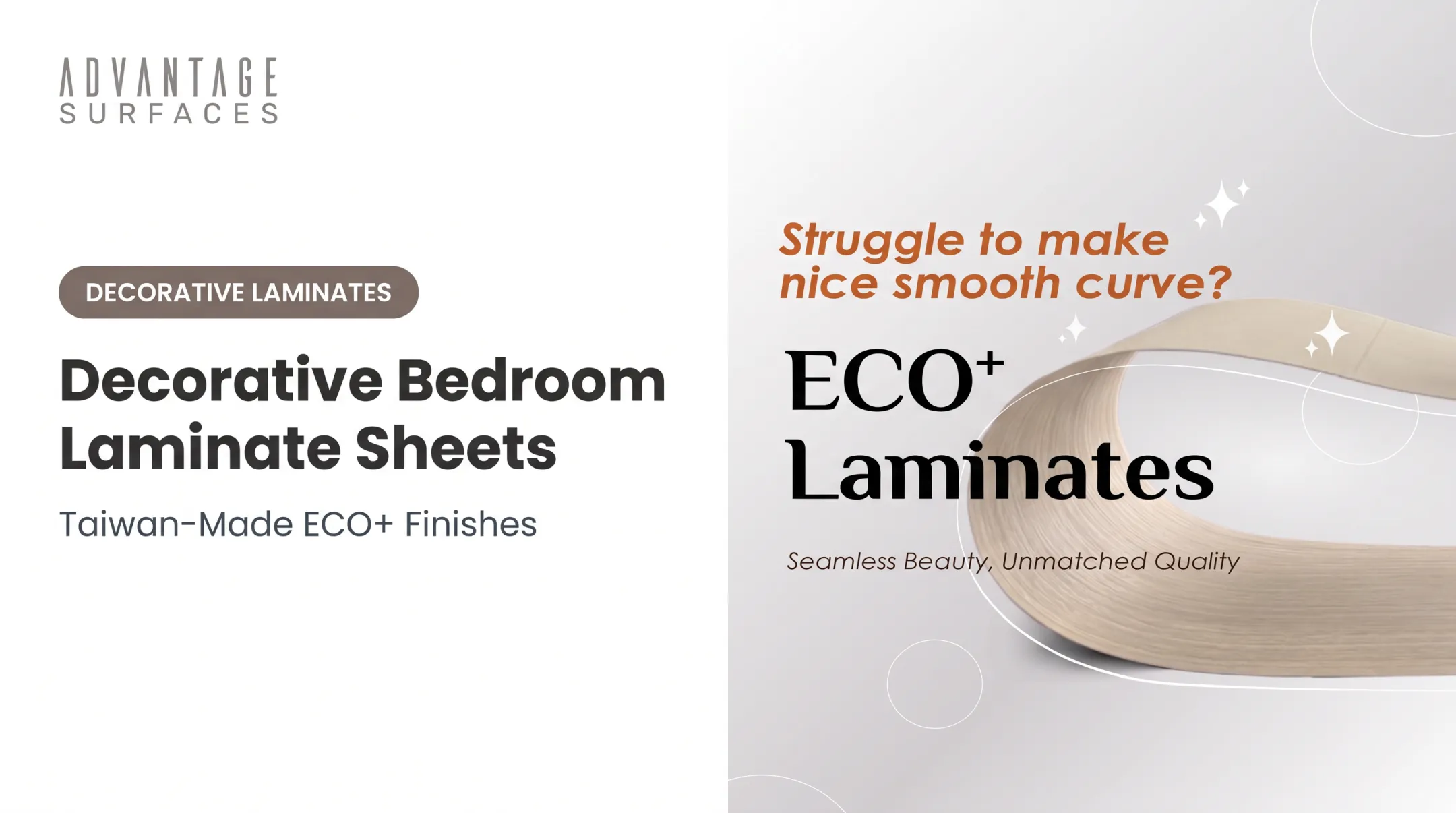
Some laminates, including the ECO+ line, handle bending and curved applications with added crack resistance during cutting and installation. Always follow the manufacturer's substrate, adhesive, and fabrication instructions. Skipping that step is the fastest way to void a warranty or crack a sheet mid-install.
Maintenance Reality Check
A stain- and scratch-resistant coating that wipes clean with a damp cloth cuts real upkeep time. For tougher spots, a non-abrasive household cleaner usually does the job. Avoid abrasive pads and harsh chemicals, though. They'll dull the finish faster than normal wear ever would.
Where Eco Laminates Can Be Used
Eco laminates work almost anywhere you need a flat, finished surface—from a single vanity refresh to full commercial interiors.
Residential and furniture applications:
- Kitchen and bathroom cabinetry
- Closets and built-in storage
- Furniture and vanities
- Wall panels and accent walls
Commercial applications:
- Retail fixtures and store interiors
- Office furniture and workstations
- Custom millwork and casework
Healthcare, education, and hospitality projects often favor eco laminate for cleanability and a consistent finish across large sheet runs. These sectors may also require flame-spread or fire-performance ratings, so confirm specs with your fabricator or authority having jurisdiction (AHJ) before you lock in a product.
For DIY Homeowners and Fabricators
Before ordering:
- Measure your project and estimate sheet quantities with some overage
- Order a sample first to check color and texture in your actual lighting
- Plan edge treatments before cutting
- Confirm finish consistency across sheets if buying in bulk
Standard ECO+ sheets run 4 ft × 8 ft at 0.8mm thickness, with custom sizes available on request.

How to Choose and Specify Eco Laminates
Before you commit to a laminate for a project, work through this checklist:
- Intended application - cabinetry, wall panels, furniture, or commercial casework
- Substrate compatibility - confirm what core material the laminate bonds to
- Sheet dimensions - standard sizes versus custom-cut needs
- Finish and edge treatment - wood-grain, solid-color, textured, seamless core or not
- Performance requirements - scratch, stain, moisture, and heat resistance for the use case
- Emissions and certifications - formaldehyde, TVOC, and any third-party documentation
- Care instructions - cleaning products and methods the manufacturer recommends
Architects, designers, and fabricators should request technical data sheets, installation guidance, and physical samples before writing a product into a finish schedule or placing a bulk order. Color consistency across production runs matters more on large commercial jobs than most people expect going in.
Apply the FTC's Green Guides here: ask any supplier to substantiate specific claims rather than accepting "eco-friendly" as a blanket statement.
Advantage Surfaces USA, based in Lakeland, Florida, a distributor of KD Panels (Keding), supplies KD Keding ECO+ laminates across wood-grain, solid-color, and textured collections, with over 200 color options.
The company offers material samples, a $35 sample book (which includes a $35 coupon toward a future order), and free standard shipping across the continental United States. Confirm current availability, pricing, and project-specific requirements directly before ordering.
Conclusion: A More Considered Approach to Sustainable Laminate
Eco laminates can genuinely balance healthier material choices, durable performance, and design freedom. But that balance only holds up when it's backed by product-specific evidence, not just a label on the box.
Before you specify or buy, compare the full picture:
- Review composition, emissions, durability, and end-of-life data
- Request product documentation
- Order a sample and evaluate it in your space
- Choose the surface that fits your project's environmental, performance, and aesthetic needs
Frequently Asked Questions
Is laminate flooring environmentally friendly?
Environmental performance depends on materials, emissions, manufacturing, and durability. This guide covers decorative interior laminates for cabinetry and surfacing, not flooring, which follows separate standards.
What kinds of laminates are there?
Decorative options include high-pressure laminate (HPL), thin fused laminate (TFL), and flexible sheets in wood-grain, solid-color, and textured finishes. These surfacing sheets are a different product category from laminate flooring.
Do high-end homes use laminate flooring?
High-end interiors sometimes use carefully specified laminate when the design fits the space. Premium decorative laminates more often appear in cabinetry, furniture, and millwork rather than as flooring.
What makes a laminate eco-friendly?
Check material composition, formaldehyde and VOC data, responsible sourcing, and manufacturing transparency. Durability and third-party documentation matter too. No single feature makes a product fully sustainable on its own.
Are eco laminates durable and easy to maintain?
Scratch-, stain-, and chemical-resistant coatings support durability, and most surfaces clean with a damp cloth. Check the manufacturer's care instructions and test data before relying on general claims.