
Color core laminate solves this specific problem. Instead of a contrasting kraft-paper core, the color runs through the sheet, so cut edges, corners, and reveals match the face.
This guide covers what color core laminate is, how it performs, where it fits in residential and commercial projects, and how it compares with conventional laminate and PVC. We'll also walk through the fabrication, sustainability, and purchasing details worth checking before you specify or order.
Key Takeaways
- Color core laminate carries color through the sheet, so cut edges match the face instead of showing a dark line.
- Scratch, stain, moisture, and heat performance depend on the specific product, not the "color core" category alone.
- Substrate choice, bonding method, and bend radius all affect whether fabrication actually goes smoothly.
- Request samples and technical documentation before specifying, especially for exposed-edge applications.
- Advantage Surfaces USA's ECO+ sheets pair the color-core construction with formaldehyde-free, food-grade polypropylene.
What Are Color Core Laminates?
Core construction basics
Standard high-pressure laminate (HPL) stacks melamine-treated decorative paper over several layers of phenolic-treated kraft paper, then fuses everything under heat and pressure. That kraft core is typically brown, which is why a cut edge shows a dark seam.
Color core laminate changes one layer: the core paper is colored or coordinated with the face instead of left natural. Through-color products carry the same color through the sheet's full thickness, which is why they avoid the dark edge line associated with traditional laminate.
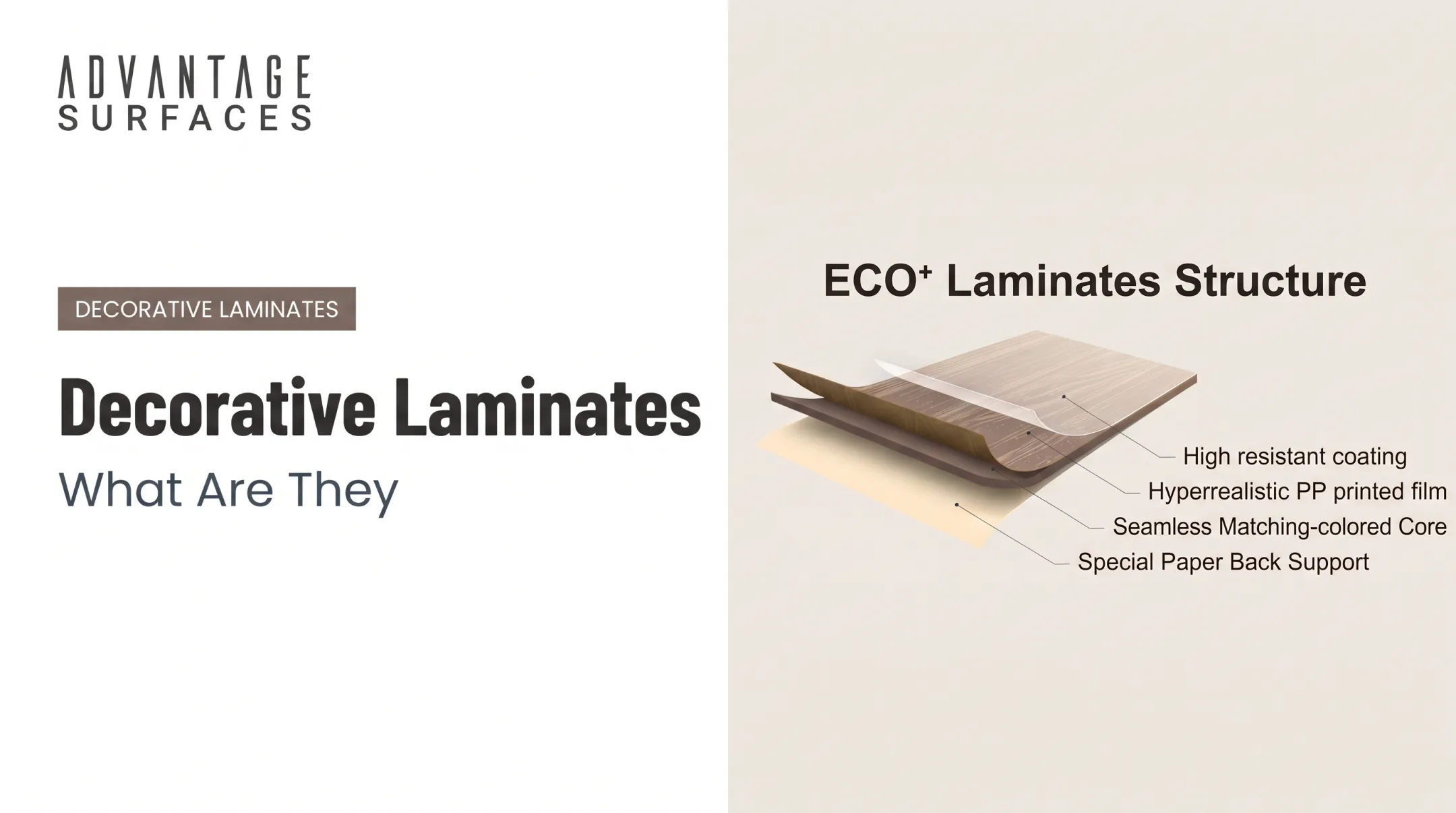
ECO+ laminates from Advantage Surfaces USA use a comparable structure: a high-resistance top coating, a hyperrealistic polypropylene printed film, a seamless matching-colored core, and a paper backing for stability.
"Color core" is a construction detail, not a performance spec. It tells you the core is colored or coordinated, nothing else. It doesn't define:
- Sheet thickness
- Grade or finish
- Substrate compatibility
- Fire, wear, or chemical ratings
Confirm those details from the manufacturer's technical sheet, not the collection name.
Where the core actually shows
The core becomes visible anywhere a sheet is cut: edges, corners, reveals, seams, routed profiles. For minimalist furniture, open shelving, or cabinetry with exposed 90-degree corners, that visibility is the whole point of choosing (or avoiding) color core laminate.
A coordinated core blends into the face color at these cut points. A standard core creates a visible contrast line that manufacturers' glue joints were never designed to hide in the first place.
One caveat worth repeating: a matching core improves color continuity, but it doesn't replace careful fabrication. Accurate cutting, routing, bonding, and corner treatment still determine whether the finished edge looks professional.
Benefits and Performance Considerations
Appearance and design flexibility
The core aesthetic benefit is edge continuity. A coordinated core reduces contrast at exposed edges, supporting cleaner corners, open shelving, and furniture components.
Design options vary by manufacturer and typically include:
- Solid colors
- Wood-grain patterns
- Stone- and metal-inspired visuals
- Matte, silky, or sandblasted textures
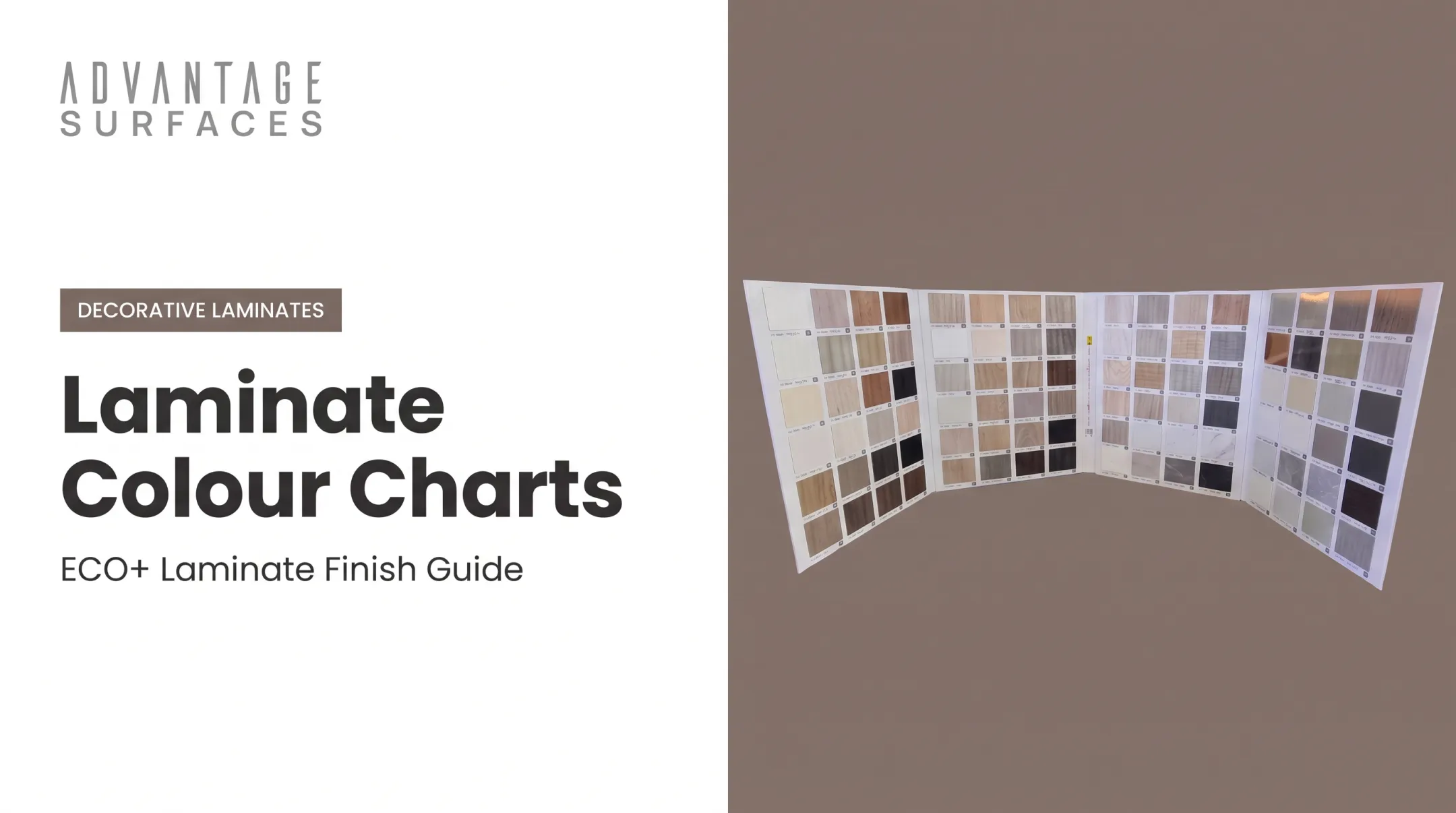
Advantage Surfaces USA's Solid Color Collection lists over 200 color options, including a muted Morandi series. Hyperrealistic printing is used across its wood-grain lines. Confirm exact availability for the specific collection you're specifying, since inventory and finishes change.
Durability and maintenance
Performance varies by product and application. One manufacturer's published technical data for its color core laminate reports typical results from its own testing. Those include surface wear exceeding 400 cycles, no effect after ten cleanability cycles, and no change after boiling-water and high-temperature exposure on most finishes. These are one manufacturer's typical values, not a universal color-core guarantee.
Maintenance expectations follow a similar pattern. Most laminates clean with a damp cloth and mild soap, with non-abrasive cleaners reserved for tougher stains. Harsh chemicals and abrasive pads stay off-limits regardless of brand. Follow the product's care sheet rather than assuming every finish tolerates the same treatment.
Fabrication and material health
Flexibility matters to shops and contractors handling cutting, bending, and forming. Advantage Surfaces USA describes its ECO+ sheets as flexible and crack-resistant for bending and installation on curved or shaped work. That claim is tied to ECO+ documentation, not laminate in general.
Material health claims deserve similar scrutiny. Federal rules under the Toxic Substances Control Act set formaldehyde emission limits for regulated composite-wood products such as particleboard, MDF, and hardwood plywood, according to EPA's formaldehyde standards. Those limits apply to the underlying wood panel, not automatically to a decorative laminate face.
ECO+ laminates use food-grade polypropylene rather than melamine resin, and Advantage Surfaces USA lists them as formaldehyde-free with low TVOC emissions. Ask any supplier for current, product-specific documentation instead of treating a collection description as a certification.
Where Color Core Laminates Work Best
Color core laminate shows up wherever exposed edges are part of the design, residential and commercial alike.
Residential applications include:
- Kitchen cabinet fronts and bathroom vanities
- Wall panels and furniture
- Shelving, desks, and tabletops with visible corners
Commercial applications include:
- Office and reception furniture
- Retail store fixtures
- Hospitality casework
- Healthcare and education interiors
Advantage Surfaces USA supplies ECO+ laminates across this same range. Confirm suitability for the project's traffic, hygiene, fire, and code requirements before specifying.
Vertical and horizontal surfaces face different stresses:
- Wall panels see mostly contact and occasional impact
- Desktops take abrasion, moisture, and repeated cleaning
Match documented performance to actual exposure, not just appearance.
For shops and remodelers, matching the laminate's sheet dimensions, thickness, and finish to the existing panel program avoids costly rework. Custom-cut sheets help here, letting fabricators order to their own panel sizes instead of forcing a standard sheet into an odd layout.
Curved or formed applications deserve a separate check. Some color core products are flat-only with no post-forming allowed, while others, including ECO+ laminates, are built for bending. Confirm the manufacturer's minimum bend radius before designing a curved detail around a specific sheet.
How to Choose Color Core Laminate for a Project
Choosing the right sheet comes down to matching documented performance to your actual project conditions, not picking by color alone.
- Define the application. Is the surface horizontal or vertical? Residential or commercial? Light use or heavy daily traffic? This determines which performance specs actually matter.
- Match performance to conditions. Check scratch, stain, chemical, moisture, heat, impact, and fire documentation against real exposure, not a generic collection description.
- Compare samples in context. Hold physical samples against cabinetry, flooring, paint, and hardware under the project's actual lighting, checking both face and cut edge.
- Confirm fabrication requirements. Verify sheet thickness, substrate compatibility, recommended adhesive, cutting and routing guidance, corner details, and bend radius before cutting a single sheet.
- Review supply logistics, including:
- Standard sheet size versus custom cutting
- Minimum order quantity and bulk pricing
- Color availability and lead time
- Replacement-sheet availability for future repairs
- Verify every claim against current technical sheets, safety documentation, and third-party certifications. A collection name isn't proof of a specific rating.

For buyers prioritizing non-toxic, food-grade construction alongside a coordinated color core, the KD Panels (Keding) ECO+ laminates distributed by Advantage Surfaces USA are one option worth comparing.
The line combines formaldehyde-free, SGS-certified scratch- and stain-resistant coatings with 200-plus colors across wood-grain and textured finishes, plus sheets made for bending and cutting.
Individual 4' x 8' sheets start at $116.99, with free shipping across the continental U.S. and no stated minimum order, making it workable for both a single vanity refacing and a multi-sheet commercial run.
Before specifying any finish, request physical samples. Advantage Surfaces USA offers a $35 sample book that includes a matching $35 coupon toward a future order. That matters most when color, texture, or batch-to-batch consistency is critical to the project.
Color Core Laminate vs. Other Surface Materials
Choosing between color core laminate, conventional laminate, and PVC comes down to how the material will be cut, installed, and used, not which one wins a generic durability contest.
| Factor | Color core laminate | Conventional HPL | PVC film |
|---|---|---|---|
| Edge appearance | Coordinated color through the sheet | Visible kraft-core line at cut edges | Depends on wrap or edge-band method |
| Forming | Often flat-only; some flexible lines bend | Typically flat panel applications | Built for thermoforming and contoured shapes |
| Fabrication | Standard cutting, routing, bonding | Standard cutting, routing, bonding | Heat-forming equipment often required |
| Best fit | Exposed edges, corners, minimalist design | Budget-driven projects where edges get banded | Curved or contoured components |
Conventional HPL still makes sense when edges will be banded or hidden, since the cost difference isn't justified if no one will see the core. Color core earns its place specifically where the edge is part of the visual design.
PVC decorative film takes a different route. It's a thermoplastic built for wrapping and thermoforming into contoured shapes, not a flat bonded panel. Those product lines focus on flexibility and shaping rather than through-color edges.
"Best" depends on who's asking:
- Designers often prioritize color continuity and appearance.
- Fabricators tend to care most about workability and consistent supply.
- Facility managers usually need documented cleaning compatibility and wear resistance.
Run through this checklist before specifying:
- Will edges stay exposed, or will they be banded?
- What moisture, impact, and cleaning-chemical exposure is expected?
- Does the application require forming or bending?
- What's the budget per sheet, including fabrication?
- Are sustainability or material-health documents required?
- How easily can a damaged panel be repaired or replaced?
Pull current technical specifications for the exact products being compared. Generic stereotypes, like "PVC is more flexible" or "laminate is more durable," break down fast once you check manufacturer-specific test data.
Frequently Asked Questions
What is core laminate?
Core laminate (or color core laminate) uses a colored or coordinated core layer instead of standard kraft paper, so cut edges match the face. Conventional laminate typically shows a dark line at corners because its core paper stays natural brown.
Which type of laminate is best?
The best laminate depends on the application, traffic level, finish, fabrication method, maintenance needs, and budget. A heavy-traffic commercial surface and a decorative wall panel call for different performance documentation.
Which is better, PVC or laminate?
Neither wins universally. PVC film suits curved, thermoformed components, while color core laminate suits flat panels where exposed edge color matters. Compare verified technical specs for the exact products in question.
Which laminates are costly?
Pricing varies by brand, construction, thickness, finish, pattern, and order quantity, plus shipping and customization. Request a current quote for the exact specification rather than relying on general price assumptions.
Can color core laminate be bent for curved surfaces?
Some can, some can't. Flat-only lines will crack if forced into a tight radius, while flexible lines like ECO+ laminates are built for bending. Always check the manufacturer's minimum bend radius first.
Do I need a professional to install color core laminate?
DIY installation works for simple, flat panels, but tight corners, curves, or large commercial jobs often benefit from experienced fabrication. Either way, follow the manufacturer's substrate, adhesive, and corner-radius guidance closely.