
But "scratch resistant" doesn't mean the surface is immune to marks. How a laminate holds up depends on its coating, texture, finish, substrate, installation, and how it's cleaned day to day. Two products with the same marketing claim can behave very differently once they're installed.
This guide breaks down what scratch resistance actually measures, what influences it in real use, and how to select, specify, and validate a laminate for residential or commercial projects across the U.S.
Key Takeaways
- Scratch resistance measures visible marking from abrasion and sharp contact, not stains, chemicals, or impact damage.
- Coating, gloss, color, texture, substrate, and fabrication quality all affect how marks show up in the real world.
- "Scratch-resistant" is not "scratch-proof." Always check current manufacturer documentation before specifying.
- Request samples, review test data, and confirm care instructions before approving a laminate for your project.
What Scratch Resistance Represents in Laminates
Scratch resistance describes a laminate's ability to minimize visible surface damage from rubbing, sliding objects, grit, or sharp edges dragged across it. It's primarily a surface-level property.
The protective coating and decorative face take the first hit. The substrate and bonding method determine whether any resulting damage stays cosmetic or turns into a deeper structural problem.
It helps to separate scratch resistance from properties it often gets lumped in with:
- Abrasion resistance covers repeated rubbing over a broader area; scratch resistance covers narrower, concentrated marks.
- Stain and chemical resistance deal with discoloration or surface reaction, not physical marking.
- Impact resistance concerns dents, cracks, or chips from a blow, not fine surface lines.
- Cleanability measures how easily marks and soil wipe off. A surface can clean up beautifully and still be prone to scratching.
A published EN 438 test report for one HPL sample separates these properties clearly. Clause 25 covers scratch resistance while Clause 10 covers surface wear. That sample scored a scratch rating of 3 and a separate wear result of 500 revolutions. The two numbers measure different things, and neither should be stretched to describe a whole product line.

Not Every Visible Mark Is a Scratch
Sometimes what looks like a scratch is really transferred material, a gloss change, or texture that's been flattened under pressure, rather than a true cut in the surface. That distinction matters for cleaning and repair decisions.
It also matters where the laminate is going. A decorative cabinet face sees different contact than a retail checkout surface, a healthcare prep surface, or a vertical wall panel. Each application carries its own realistic wear pattern, and that should shape how you weigh a product's resistance claims.
Factors That Influence Scratch Resistance in Real-World Operation
A laminate can pass a controlled lab test and still show marks on-site. Lab testing uses standardized tools and pressure; real life involves dragged furniture, dropped keys, pet claws, and whatever cleaning product happened to be under the sink.
Coating, Texture, and Gloss
The protective coating does most of the work. It governs surface hardness, friction, and how well the laminate resists visible marking. Always check the manufacturer's current coating description and test documentation rather than relying on a general product category.
Texture plays a role too, though not the one people assume:
- Textured and embossed surfaces scatter reflected light, which can make minor marks less noticeable.
- Texture doesn't automatically mean the surface is physically harder or more scratch-resistant.
- Gloss level changes how a mark appears depending on lighting and viewing angle.
One manufacturer's laminate care guidance notes that rough and smooth textures each have situational advantages, and it doesn't recommend high-gloss laminate for heavy-duty use.
The same guidance flags that dark, solid colors tend to show scratches and fingerprints more readily than wood-grain or varied patterns. There's nothing to break up the visual contrast when light hits a mark.
Design and Fabrication
Several fabrication factors create stress points where damage shows up first:
- Substrate flatness and bonding quality
- Unsupported edges and sharp corners
- Leftover fabrication debris on the surface
A laminate with excellent lab scores can still underperform if it's bonded poorly or installed over an uneven substrate.
Operating Conditions
High-traffic environments put different demands on a surface:
- Residential kitchens deal with utensils, cookware, and cleaning frequency.
- Commercial and healthcare settings deal with carts, equipment, and badges.
- Retail and hospitality spaces deal with constant hand contact and foot traffic nearby.
Temperature swings, humidity, repeated chemical exposure, and improper installation can all accelerate wear over time, even on a well-made product.
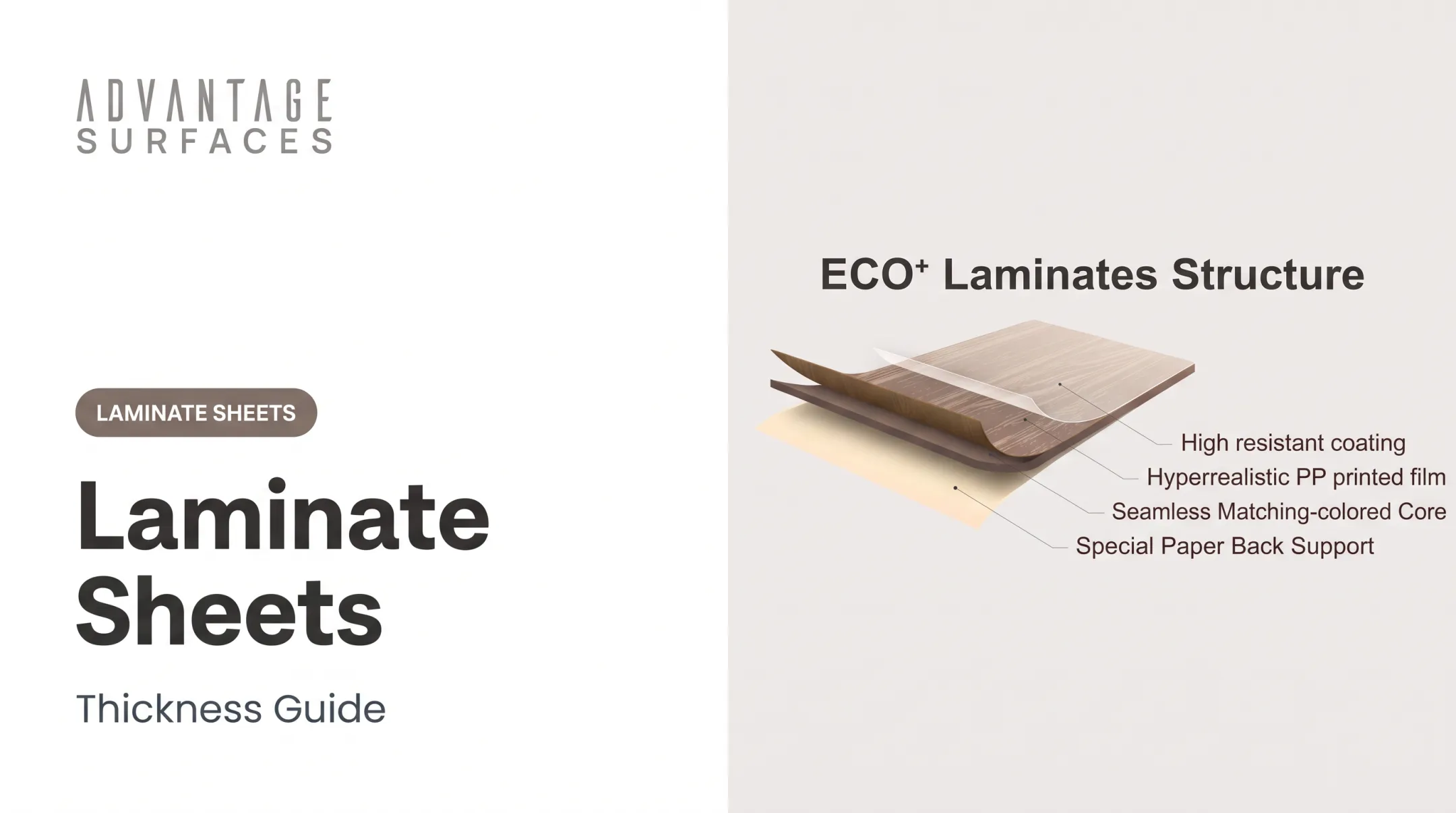
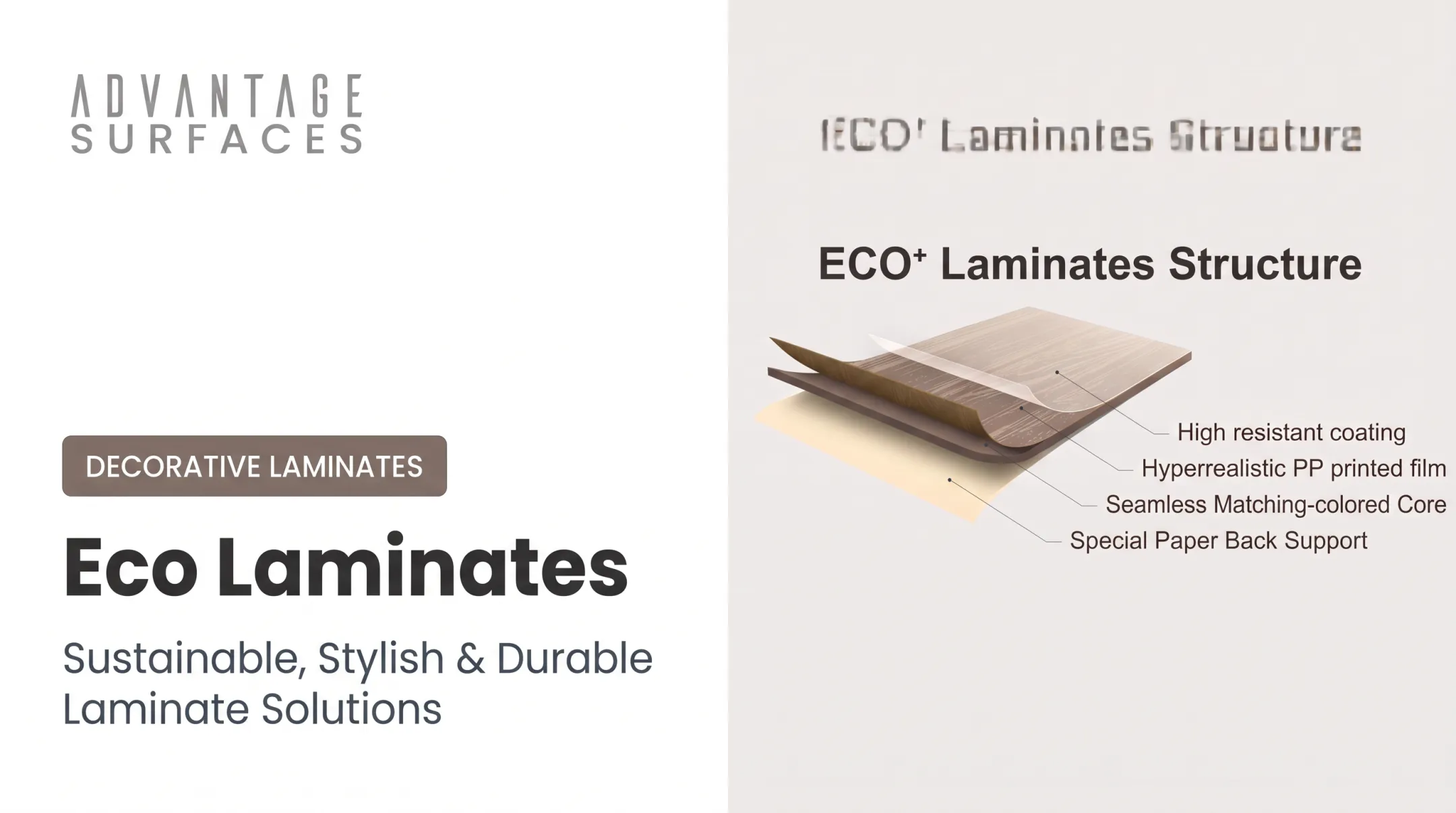
When you compare products for these conditions, look at how the coating is built. ECO+ laminates distributed by Advantage Surfaces USA use a four-layer structure:
- Protective high-resistance coating
- Hyperrealistic printed film
- Seamless color-matched core
- Paper backing layer
The company cites an SGS-certified coating for scratch, stain, solvent, alcohol, and chemical resistance. Use that as a starting point for comparison, and confirm current technical documentation for your project rather than treating the certification as a blanket guarantee.
Range, Limits, and Care Considerations
A laminate's real performance range comes from its grade, intended orientation, tested use category, substrate, and care instructions, not from the phrase "scratch resistant" printed on a brochure.
Continuous abrasion, sharp tools, dragging heavy or gritty objects, and harsh cleaning products can exceed the design intent of even a well-built laminate.
Everyday Care That Actually Protects the Surface
A few habits keep the surface within its design limits:
- Remove grit promptly before it gets ground into the surface by a cloth or sleeve.
- Use a soft cloth and a manufacturer-approved cleaner, not whatever's closest under the sink.
- Avoid abrasive pads, scouring powders, and harsh chemicals, which can dull and scratch laminate permanently.
- Lift, don't drag, heavy or textured objects across the surface.

NEMA's care and cleaning guidance for laminates recommends a damp cloth with mild soap or detergent for routine cleaning. Its care annex flags abrasive pads and scouring cleansers as a cause of permanent dulling and scratching.
ECO+ laminate care follows the same logic: a damp cloth and mild soap handle most daily cleaning, with a non-abrasive household cleaner reserved for tougher spots.
When a Mark Becomes a Repair Issue
Minor surface marks can sometimes be blended or minimized with an approved repair product.
Deep gouges, exposed substrate, chipped edges, or a failed bond are a different category. Those usually mean component replacement, not a touch-up. Check with the manufacturer before attempting any repair yourself.
How to Choose, Specify, Measure, and Validate Scratch-Resistant Laminate
Selecting a laminate is a project-specific decision. It should weigh aesthetics, expected contact, cleaning routines, fabrication method, and how visible wear would actually look once the project is in use.
What to Pull From a Technical Datasheet
Before approving a product, collect:
- Product construction, coating type, finish, thickness, and intended orientation
- Substrate compatibility and edge-fabrication guidance
- Scratch, abrasion, chemical, stain, and impact test methods, plus the standard used and whether results cover the full assembly or only the laminate face
- Whether a rated value is a tested minimum or a general manufacturer claim
Don't treat an unverified number as a universal threshold. If a datasheet doesn't specify the test standard or lab conditions, ask for them.
Evaluating a Physical Sample
Numbers only tell part of the story. Get a physical sample and:
- Inspect the finish under the lighting and viewing angles your project will actually have
- Compare matte, gloss, textured, wood-grain, and solid-color options side by side for both resistance and mark visibility
- Confirm the sample reflects current production, not an older run
- Request a larger panel if seams, edges, or pattern repeat matter for your layout
Validating Before You Commit
Start with supplier documentation, then arrange a controlled sample test using your actual substrate, bonding method, fabrication process, and cleaning products. That is the only reliable way to judge performance under your conditions rather than a generic lab setup.

KD Keding ECO+ laminates from Advantage Surfaces USA, a distributor of KD Panels (Keding), use an SGS-certified coating for scratch, chemical, and stain resistance. Use that rating as a comparison point, then review current technical documentation rather than treating certification as proof the surface cannot be marked.
The company also offers material samples and a $35 sample book (with a $35 credit toward a future order). Designers, fabricators, and homeowners can check color, texture, and finish before ordering a full sheet.
Implications of Operating Outside the Recommended Range and Common Misinterpretations
Using a laminate beyond its tested or intended conditions tends to show up fast: visible scuffing, gloss change, localized gouging, edge chipping, discoloration, or in worse cases, delamination.
A strong finish can't make up for poor substrate prep, bad bonding, dragged debris, or aggressive scrubbing. Coating quality alone won't prevent those failures.
A few misunderstandings come up often enough to flag directly:
- "Scratch-proof" is marketing shorthand. No laminate on the market can guarantee that nothing will ever mark it.
- A strong abrasion score doesn't cover everything. Abrasion, scratch, impact, and chemical resistance are tested separately, and a good result in one doesn't guarantee a good result in another.
- Flooring AC ratings don't transfer to architectural sheet laminate. NALFA's AC1–AC6 wear classification applies to laminate flooring only, not cabinet-grade or wall-panel sheet unless a manufacturer explicitly says otherwise.
- A textured finish that hides marks isn't necessarily harder. Appearance and actual resistance are two separate evaluations, and both deserve attention before you specify.
Conclusion
Scratch resistance in laminate is shaped by the coating, texture, color, substrate, fabrication, and how the surface gets used and cleaned day to day. It's a real, measurable performance property, not a label you can take at face value.
The most reliable way to specify a laminate is to combine current technical documentation, a project-specific sample test, physical sample review, correct fabrication practices, and realistic care expectations. That combination tells you far more than any single marketing claim ever will.
Frequently Asked Questions
Is laminate scratch resistant?
Most laminate is designed to resist everyday scratching, but actual performance varies by coating, finish, construction, and how it's maintained. It's not completely scratch-proof, so matching the product to your expected use matters.
What's the difference between scratch proof and scratch resistant?
Scratch-resistant means a surface reduces the likelihood or visibility of marks under normal conditions. Scratch-proof implies total immunity, which almost no laminate product can actually guarantee.
Can you fix scratches on laminate?
Superficial surface marks can sometimes be blended or minimized with an approved repair product. Deep gouges, chipped edges, or exposed substrate typically require professional repair or component replacement, per the manufacturer's guidance.
What is the most scratch proof flooring?
This article covers interior sheet laminates for cabinets, millwork, and panels, not flooring. No flooring product should be marketed as completely scratch-proof; compare product-specific test data for your actual use case.
What is the best scratch resistant laminate flooring?
Flooring performance depends on traffic levels, pets, moisture, installation method, and verified AC ratings. Those flooring-specific criteria shouldn't be applied to cabinet or wall-panel laminate decisions.
Which is more scratch resistant, laminate or LVP?
Neither category wins outright. Compare the specific products' wear layers, test methods, and manufacturer documentation rather than assuming one material type automatically outperforms the other.